TLDR
- Most compliance teams spend the majority of their time on administrative work: chasing approvals, reconciling versions and rebuilding attestation records, not the strategic work they were hired for.
- That's not an efficiency problem. It's a retention problem, and it has a real price tag in a tight labor market.
- The lag between a regulation's effective date and the moment an organization is operating in compliance is measured in weeks for most teams on manual tools.
- The answer isn't to do the manual work faster. It's to remove it from the people who shouldn't be doing it. That's exactly what Policy Manager from Ntracts was built to do.
Healthcare policy management is one of the most consequential and least visible categories of work in any health system. It doesn't appear on a job description, it doesn't show up in productivity reports, and it rarely gets discussed in leadership meetings...until the week before a survey, when suddenly it's the only thing anyone is talking about.
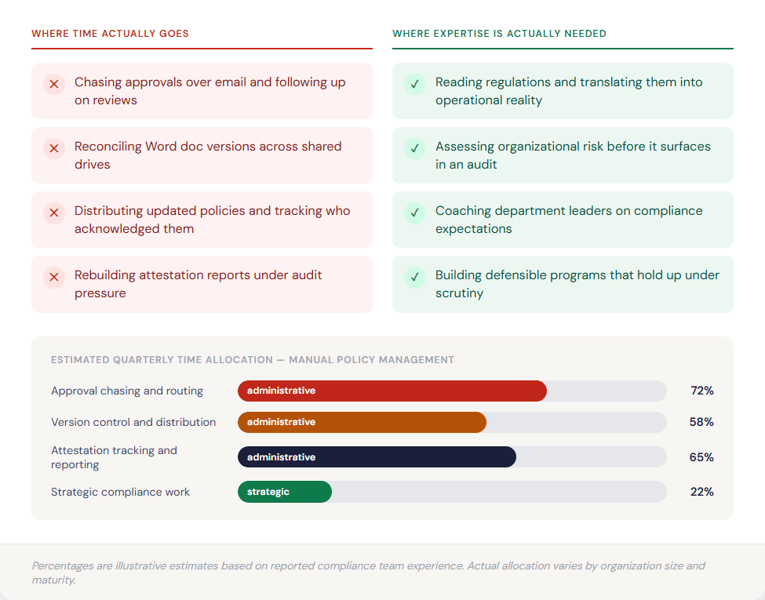
For most compliance teams, the policies themselves aren't the hard part. Writing them, updating them, and aligning them to regulatory standards is the work compliance professionals were hired to do. And most of them are good at it. The hard part is everything that surrounds the policy: routing it for review, tracking down approvals, reconciling versions, distributing it to staff, capturing attestation and producing audit evidence on demand. That's the work that quietly consumes the calendar. And it's heavier than any org chart admits.

The hidden costs of manual healthcare policy management.
Ask a compliance director how much time their team spent last quarter chasing approvals over email, and the answer is almost always a guess. Ask how many hours went into reconciling Word doc versions across shared drives, and the guess gets vaguer. Ask how long it took to rebuild an attestation report under audit pressure, and you'll usually hear a sigh before the number.
These hours don't get tracked because they don't fit neatly into any one project or task. They're administrative dark matter—present every week but never quite visible enough to budget for. But they add up fast.
According to HIPAA Journal, at least 43% of HIPAA-covered entities still rely on manual tools for compliance tracking, and the same reporting finds healthcare compliance professionals broadly describe themselves as stretched thin under the weight of complex regulations and emerging risks.
For most healthcare organizations still managing policy in shared drives and Word documents, manual policy management quietly consumes hundreds of hours every quarter. None of those hours show up in a job description. All of them show up on someone's calendar.
Why healthcare policy management is a talent problem.
The conventional framing treats this as an efficiency problem. If we could just do it faster, the thinking goes, the cost would go away. But the more honest framing is that it's a talent problem.
Compliance professionals weren't hired to chase signatures. They were hired for their judgment.
When the majority of their week goes to administrative logistics, two things happen.
- The strategic work that actually requires their expertise gets pushed to the margins, where it's done in a hurry or not at all.
- And the people doing it start to feel the mismatch between why they took the job and what the job has become.
That's not a productivity issue. That's a retention issue. And in a labor market where compliance talent is increasingly hard to find and harder to keep, it's an issue with a real price tag.
Why the policy management burden gets worse every year.
The pace of regulatory change in healthcare is accelerating, not slowing. CMS payment expansions, tightened prior authorization rules, evolving HIPAA expectations, the first round of Medicare drug price negotiations, a growing patchwork of state-level AI disclosure laws; these are just the federal and state headlines from a single calendar year. Each one cascades into multiple internal policy updates. Each policy update requires review, approval, distribution, training and attestation. Each of those steps adds work to a team already running at the edge of capacity.
Organizational complexity compounds the problem. More staff, more roles, more sites of care, and more credentialing categories all mean more attestation cycles. A policy that affected 50 staff members a decade ago might affect 500 today. The work to maintain it has scaled accordingly, except the team responsible for it usually hasn't.
The result is a quiet, structural lag between the moment a regulation changes and the moment an organization is operating in compliance with that change. For most healthcare organizations on manual tools, that lag is measured in weeks. Sometimes months. Meanwhile, the enforcement clock starts on the regulation's effective date, not the day your review cycle catches up.
What modern healthcare policy management looks like.
The good news is that this is a solved problem in adjacent industries and increasingly in healthcare. The right approach isn't to do the manual work faster. It's to remove the manual work from the people who shouldn't be doing it in the first place.
In practice, modern healthcare policy management looks straightforward:
- Automated policy workflows that route, remind and escalate without a person managing the inbox
- Centralized version control with built-in checkpoints so the current version is always the visible one
- Centralized attestation tracking that captures completion in real time across every employee and role
- Dashboards and reporting that produce audit-ready evidence in minutes rather than panic-week
- 24/7 access so the right policy is one search away, not three folders deep on a shared drive
When the workflow handles the logistics, the team handles the work that actually requires their judgment.
Regulatory response gets faster, risk analysis gets sharper, and the relationship between compliance and operations starts to look like strategic partnership rather than administrative gatekeeping. That's the after-state. It's not aspirational, it's how the best-run policy programs in healthcare are already operating.
How policy management software lifts the burden.
If your compliance team is spending more time on administrative work than on the work they were hired for, you're not alone (and the answer isn't to ask them to work harder). The answer is to give them a system designed for the way modern healthcare policy management works.
That's what Policy Manager from Ntracts was built to do. Automated policy workflows with built-in checkpoints. Centralized version control. Dashboards and reporting that give leadership real-time visibility into policy status and staff compliance. Audit-ready evidence on demand. All built by a team that has been delivering best-in-class healthcare governance software for 35+ years.
The hours your team spends on logistics are hours they're unable to spend on judgment, and it's worth considering what's possible when those hours come back.

Frequently Asked Questions About Healthcare Policy Management
What is healthcare policy management?
Healthcare policy management is the end-to-end process of creating, reviewing, approving, distributing and attesting to the internal policies and procedures that govern how a healthcare organization operates. It covers everything from clinical practice policies and HIPAA procedures to environment-of-care protocols and human resources standards, and it's the workflow that ensures every staff member is operating under the most current, regulator-aligned version of every policy.
Why is healthcare policy management so difficult to do manually?
Manual healthcare policy management relies on shared drives, email approvals and spreadsheet attestation tracking; these tools were never designed for the scale or pace of modern healthcare. The result is version drift across departments, approval cycles that stall in inboxes, attestation gaps discovered during audits and hundreds of hours per quarter consumed by administrative work that adds no clinical or compliance value.
What features should healthcare organizations look for in policy management software?
The most important capabilities are automated policy workflows, centralized version control with full audit history, centralized attestation tracking across roles and departments, real-time dashboards and audit-ready reporting, and 24/7 access with strong search. Integration with regulatory notification systems so that federal and accrediting agency updates can trigger relevant policy reviews is increasingly considered table stakes.
How does policy management software improve regulatory compliance?
By automating the workflow that connects regulatory change to operational compliance. When a new regulation is finalized, policy management software routes the affected policies for review, tracks every revision, distributes the updated policy to relevant staff, captures attestation in real time, and produces an audit-ready trail of the entire process. This closes the lag between a regulation's effective date and the moment an organization is genuinely operating under it.