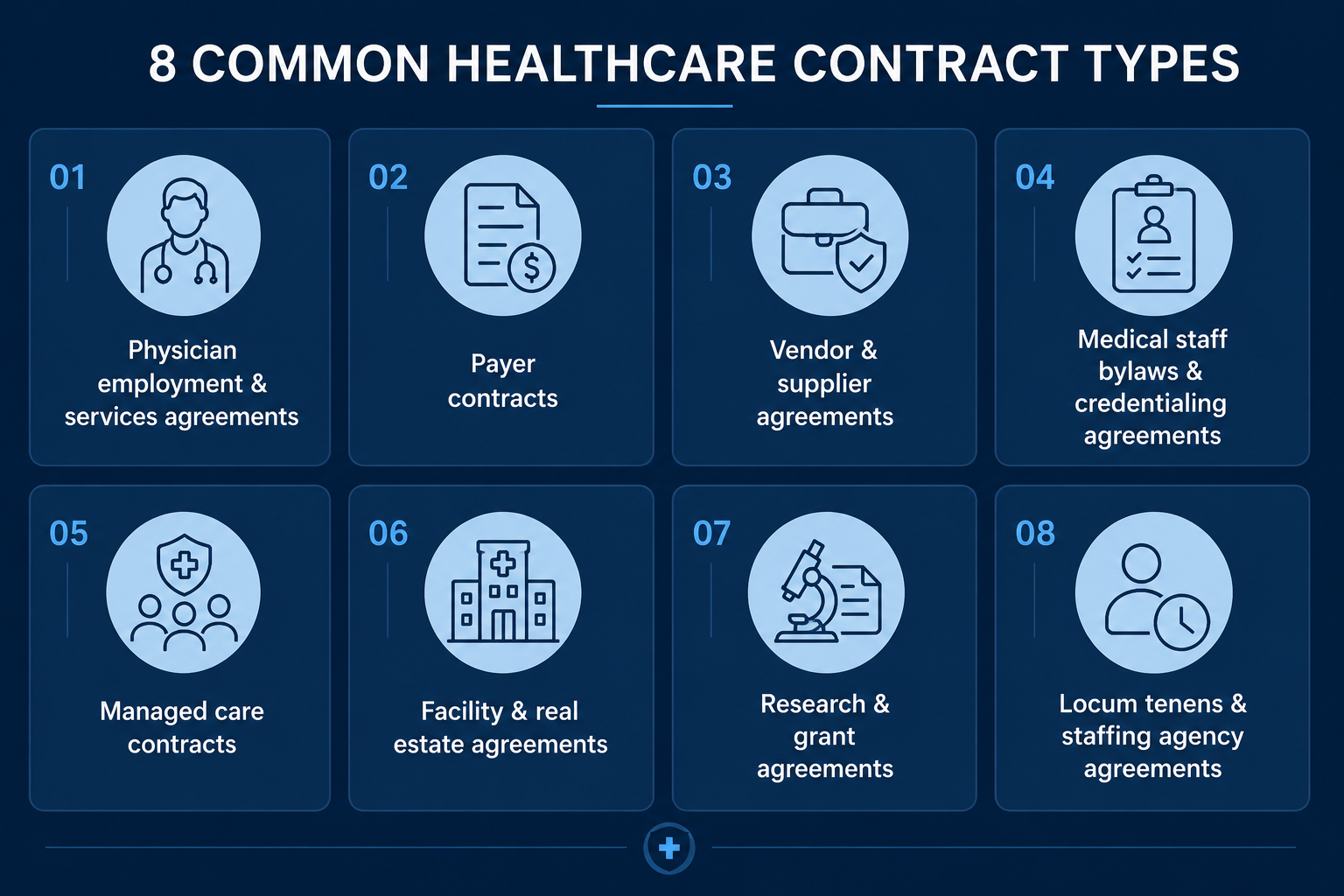
Every contract in a healthcare organization carries regulatory weight that standard commercial agreements do not. Here is what that means across the eight types healthcare teams manages most.
A vendor agreement in a retail business is a purchasing decision, but in a healthcare organization, it is a compliance obligation. The same is true for physician compensation structures, payer negotiations, research sponsorships and supplier agreements across the portfolio. What separates healthcare contracting from standard commercial contracting is not volume or the nature of the business relationships behind the agreements. It is the regulatory overlay that attaches to each contract type, and that simply does not exist outside of healthcare.
Stark Law, the Anti-Kickback Statute, HIPAA Business Associate Agreement requirements, fair market value documentation, provider credentialing standards: these obligations attach differently to each contract type, and missing any one of them creates real exposure. No matter the complexity of the contract type, the Ntracts implementation team knows how to configure a solution around your organization's unique workflows and portfolio, giving compliance and legal teams the visibility to stay ahead of obligations rather than react to them.
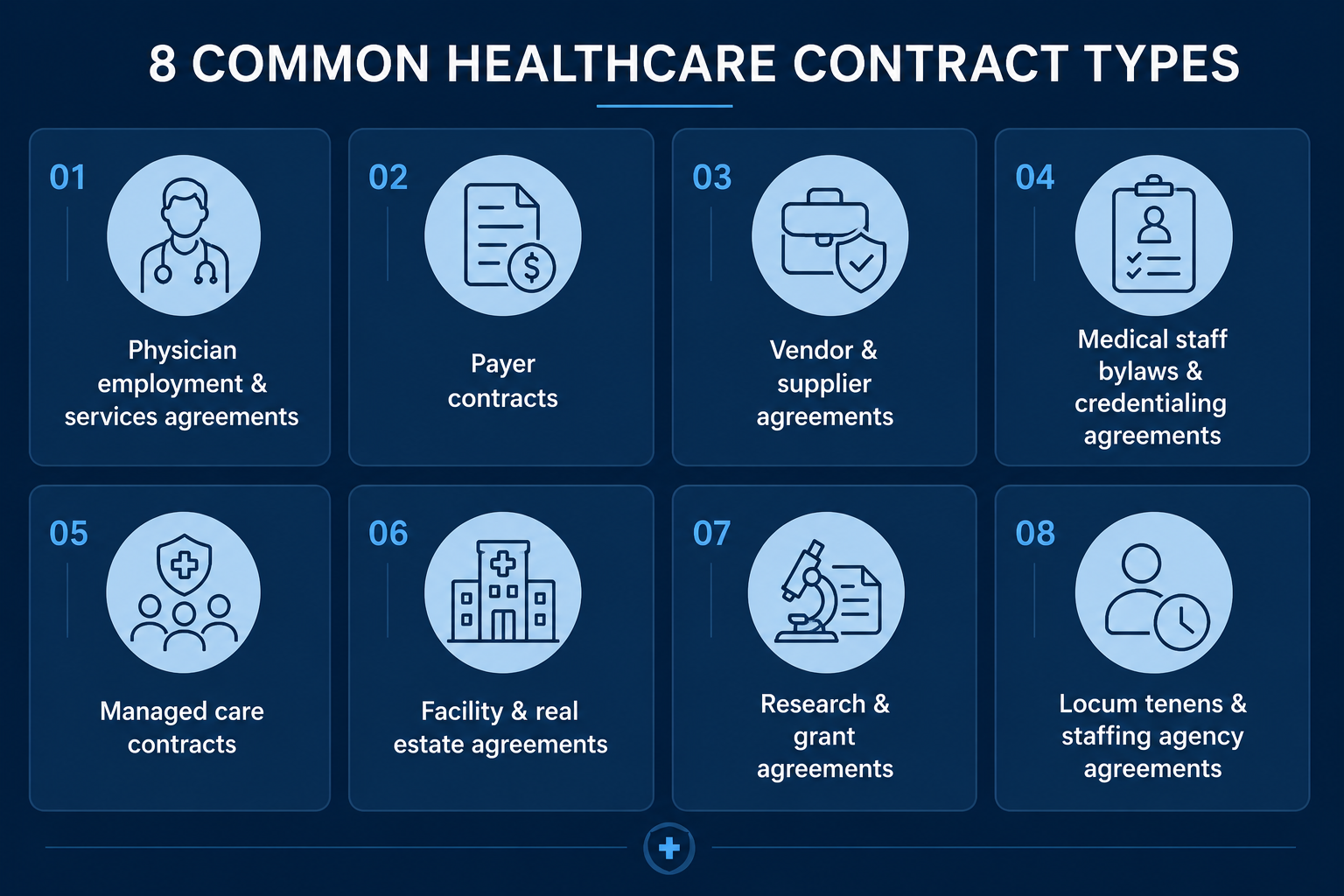
Below is a breakdown of eight common contract types healthcare compliance and legal teams manage, but these are just a starting point. A mature healthcare contract portfolio spans dozens of agreement types, and Ntracts' healthcare contract management software is built to support all of them.
Disclaimer: the example contracts that follow are purely fictional and for educational purposes. They should in no way be used for real-world contract negotiations.
1. Physician employment and services agreements
High regulatory complexity
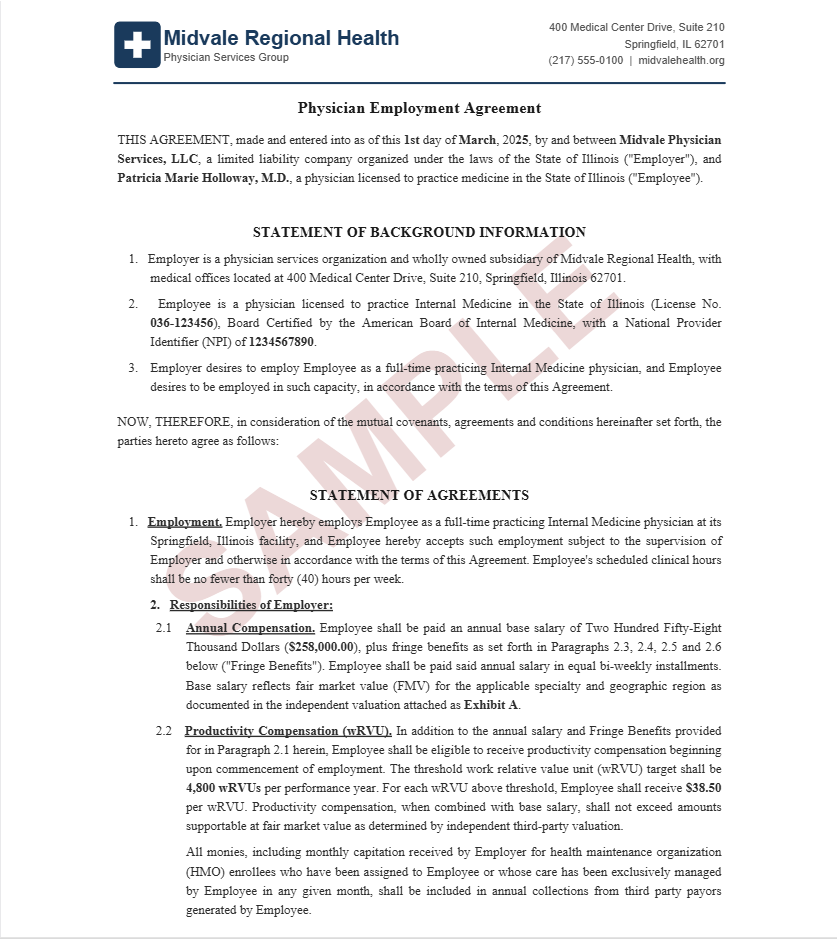
Physician contracts sit at the intersection of Stark Law, the Anti-Kickback Statute and fair market value (FMV) requirements in a way no other contract type does. Every compensation arrangement with a referring physician must be structured to meet a Stark Law exception, and the compensation paid must reflect FMV at the time the agreement is executed and throughout its term.
The compensation structure itself adds complexity. Physician agreements routinely include base salary, work relative value unit (wRVU) productivity targets, quality and performance bonuses, call pay and directorship stipends. Each component needs to be documented, defensible and consistent with what an independent valuation would support.
What to watch for:
- Agreements that auto-renew without FMV redetermination
- Compensation structures that have drifted from documented benchmarks
- Missing written agreement requirements for Stark Law exceptions
These are among the most scrutinized contracts during a government investigation or self-disclosure review.
Example of a physician employment agreement:
2. Payer contracts
Highest financial impact
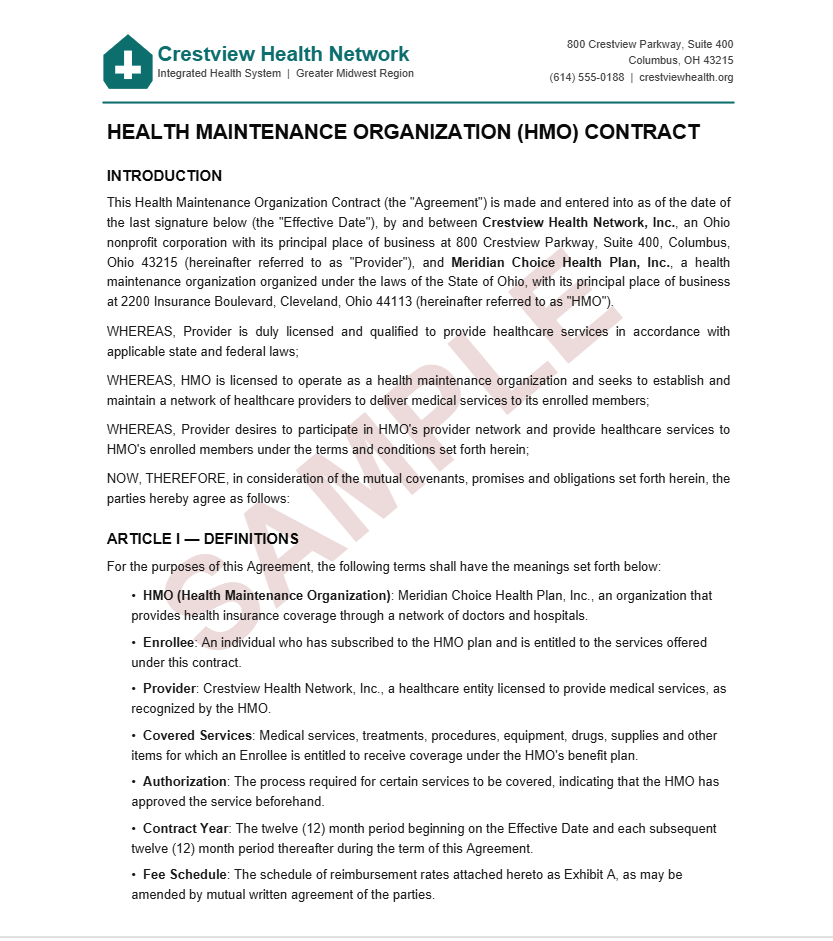
Payer contracts are often the highest-value agreements in the portfolio and among the least actively managed. Reimbursement rates, carve-out provisions, timely filing requirements and network participation terms all drive revenue directly. A missed renegotiation window can lock an organization into below-market rates for years.
Auto-renewal clauses are particularly costly here. When a payer contract renews on its own terms without a renegotiation trigger, the organization absorbs the rate structure from the prior term regardless of how costs, payer mix or service volume have changed. Most organizations do not discover the missed window until well after the renewal date has passed.
What to watch for:
- Auto-renewal dates without renegotiation alerts
- Rate schedules that have not been reviewed against current cost structures
- Inconsistencies between the contract terms and what is actually being billed
Payer contracts require the same active management cycle as any high-value vendor relationship.
Example of a payer contract:
3. Vendor and supplier agreements
HIPAA and exclusion risk
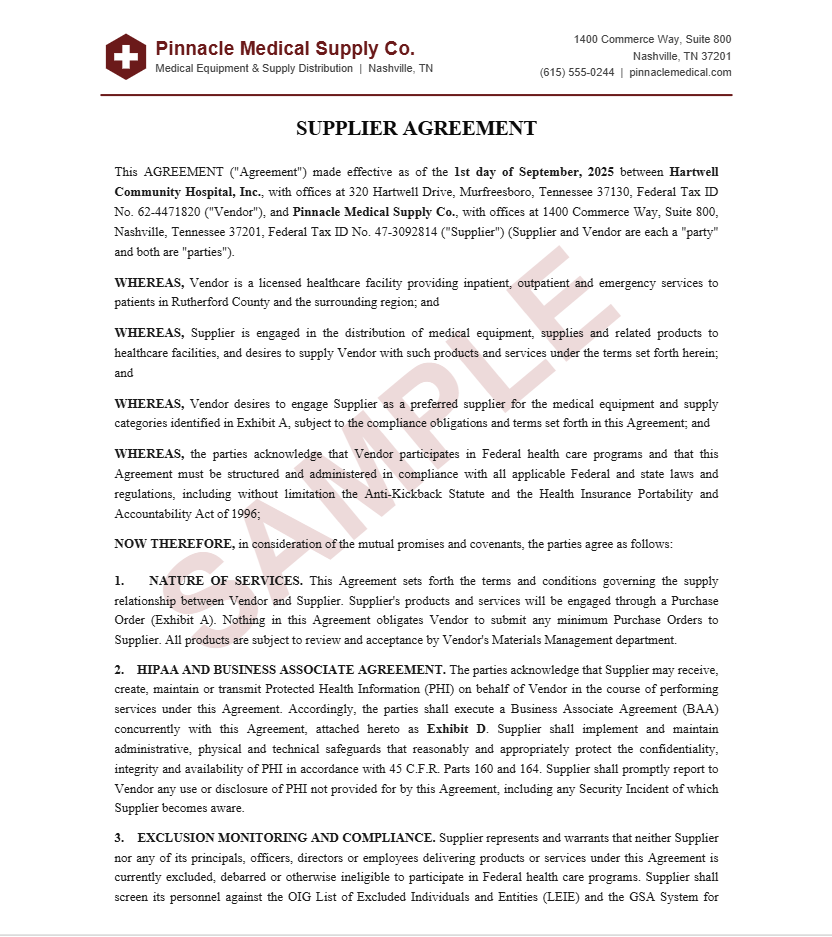
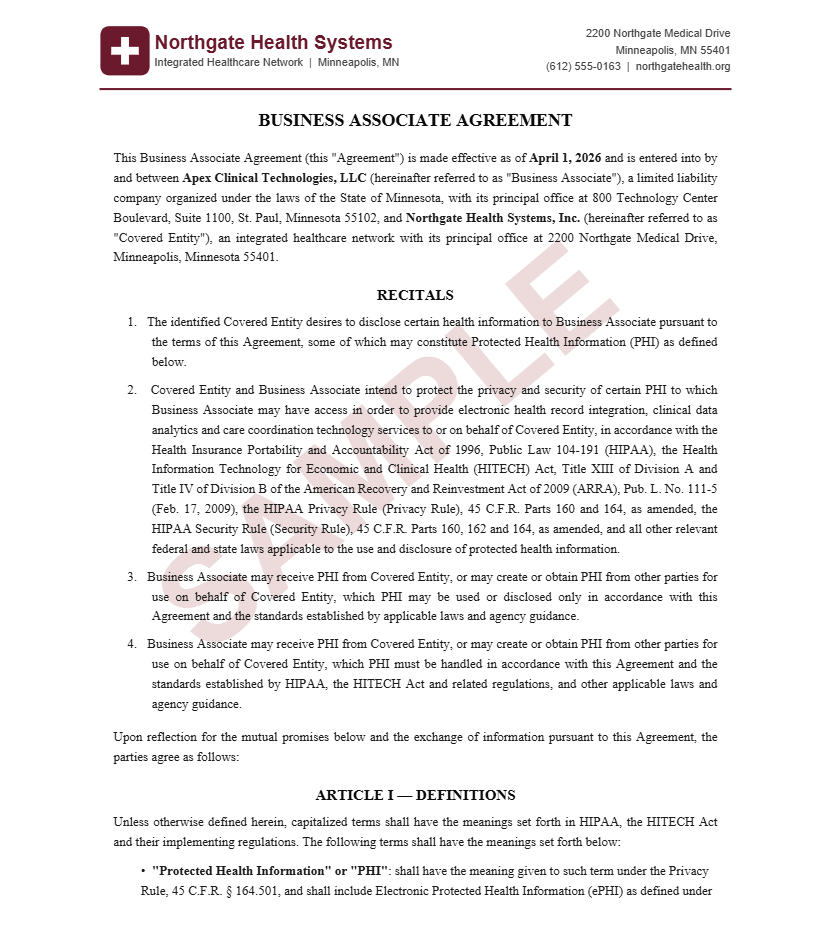
Any vendor with access to protected health information (PHI) requires a Business Associate Agreement (BAA) before work begins. The BAA is not a formality. It is a required element of HIPAA compliance, and an organization that cannot produce a current, executed BAA for a vendor accessing its systems is out of compliance regardless of whether a breach has occurred.
Vendor agreements also carry exclusion monitoring obligations. If a vendor or any of its principals appears on the OIG List of Excluded Individuals and Entities (LEIE), the GSA System for Award Management (SAM) or an applicable state exclusion list, payments made to that vendor can trigger repayment liability under federal health program rules.
What to watch for:
- Vendor agreements predating the current compliance program that were never updated to include BAA language
- Vendors whose exclusion status has not been monitored at the required frequency
- Contracts with scope-of-work terms broad enough that PHI access is unclear
Legacy vendor agreements are a consistent finding in compliance program assessments.
Example of a supplier agreement:
Example of a Business Associate Agreement (BAA):
4. Medical staff bylaws and credentialing agreements
Accreditation and onboarding risk
Medical staff bylaws govern who can practice at a facility and under what terms. They define the credentialing and privileging process, outline peer review rights and establish the procedures that govern corrective action. When bylaws are outdated, they may no longer reflect current accreditation standards, state licensing requirements or internal governance policies.
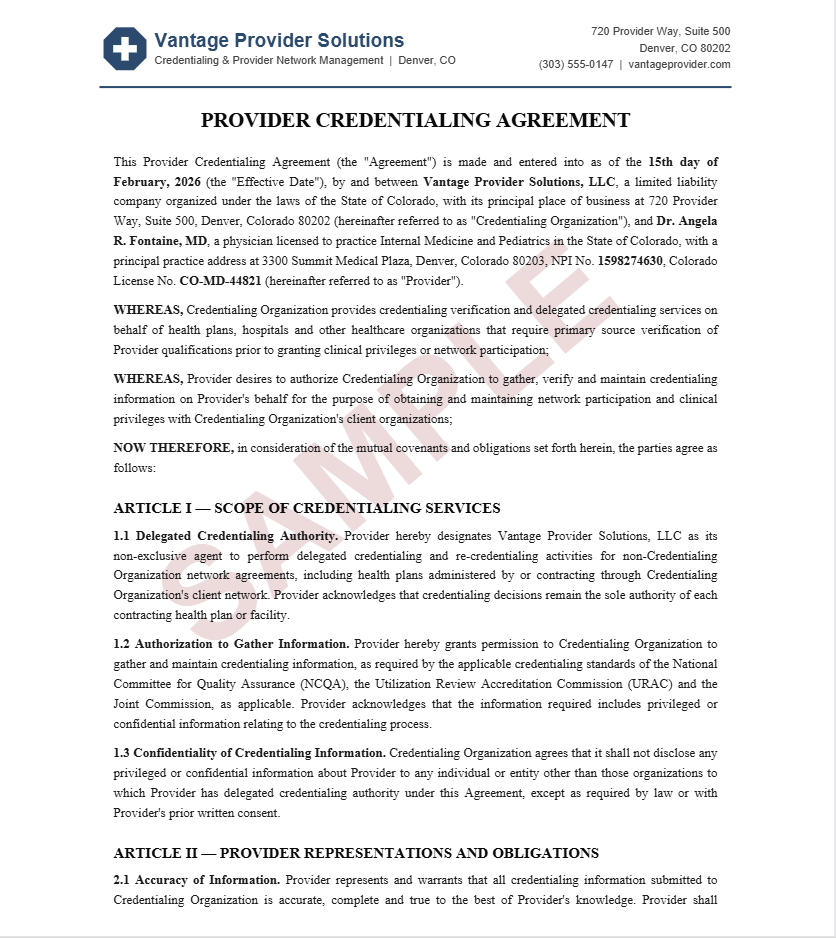
Credentialing agreements connect directly to provider onboarding timelines. A physician who cannot be credentialed and privileged cannot see patients, bill for services or generate revenue.
Delays in this process typically trace back to documentation gaps: missing primary source verifications, expired licenses, incomplete work history or unresolved malpractice history that was not flagged early.
What to watch for:
- Bylaws that have not been reviewed following an accreditation survey
- Credentialing files with incomplete primary source documentation
- Privileging approvals that outpace the verification process
The cost of an onboarding delay is measured in lost revenue from day one.
Example of a provider credentialing agreement:
5. Managed care contracts
Billing and service line complexity
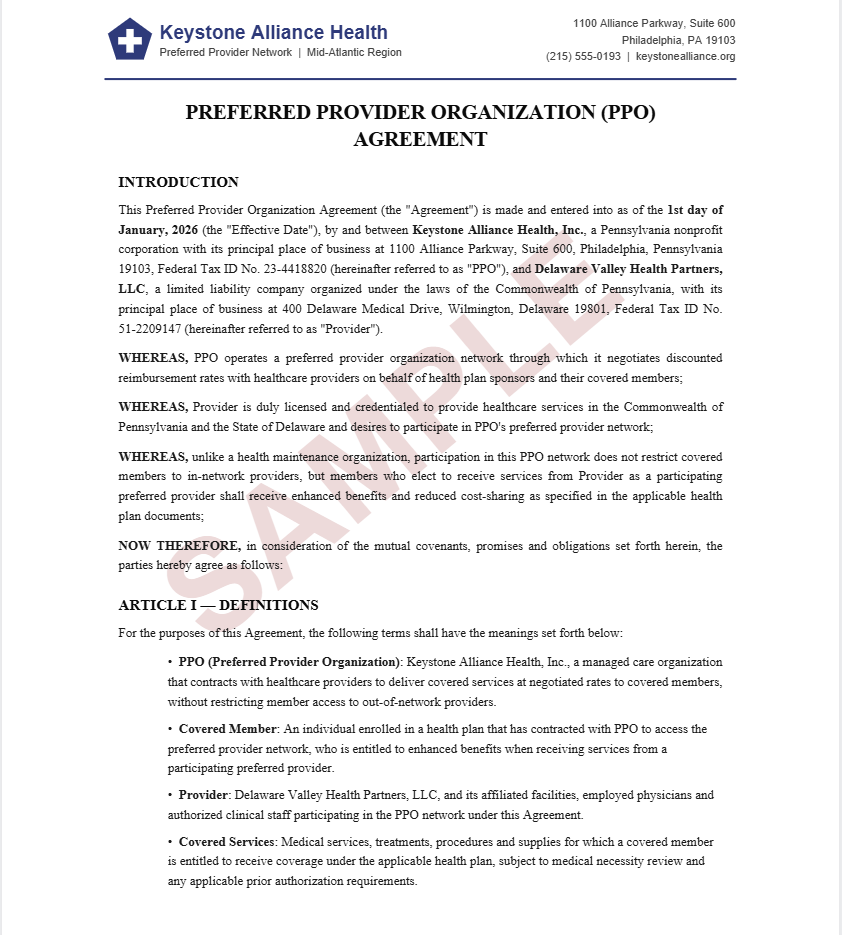
Managed care contracts differ from direct payer contracts in structure and scope. They typically govern relationships with managed care organizations that then administer benefits on behalf of an underlying payer, which introduces an additional layer of terms and an additional layer of billing complexity. Carve-outs for specific services, behavioral health, specialty pharmacy or post-acute care, are common and frequently buried in addenda.
When carve-out terms are not clearly mapped to billing workflows, claims for carved-out services get submitted under the wrong agreement or to the wrong payer. The result is claim denials, delayed reimbursement and potential overpayment liability if the error is not caught and corrected promptly.
What to watch for:
- Managed care addenda that have not been integrated into billing guidance
- Carve-out provisions affecting service lines that were added after the original contract was executed
- Rate schedules that apply to some but not all covered services
These contracts benefit significantly from structured term extraction rather than manual review.
Example of a preferred provider organization (PPO) agreement:
6. Facility and real estate agreements
Compliance, operational and financial risk
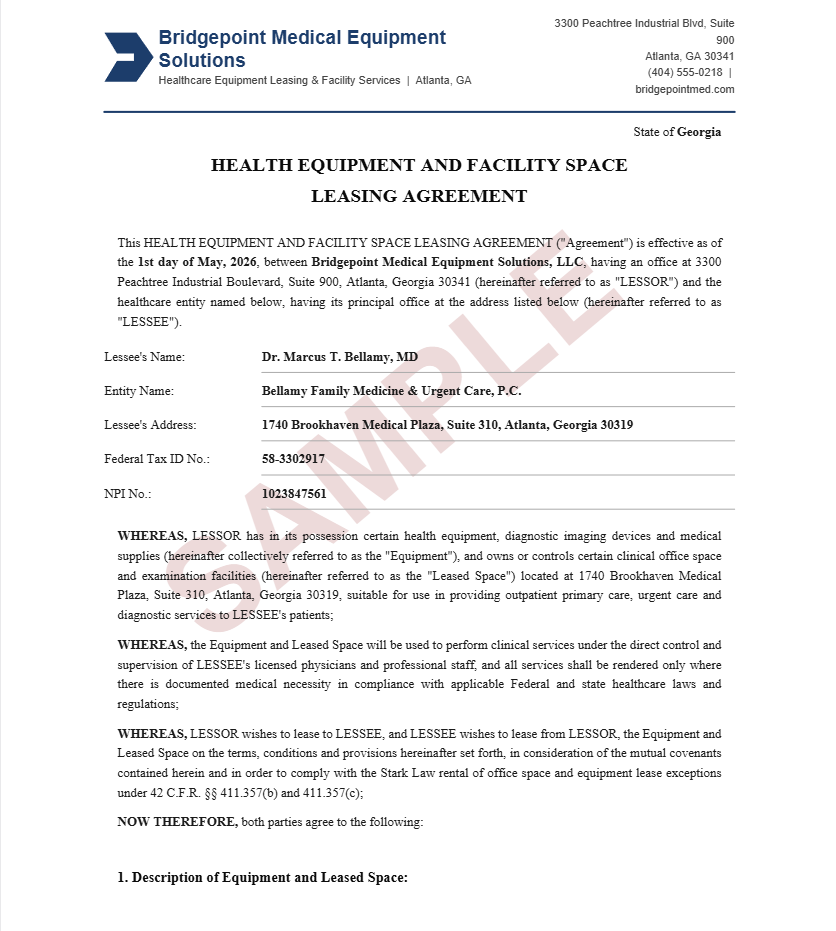
Facility and real estate agreements govern the physical locations where care is delivered or operations occur. They cover a wide range of arrangements: medical office leases with employed physicians or independent groups, ground leases for outpatient centers and ambulatory surgery sites, space use agreements where a specialist rents exam rooms one day per week, equipment leases for MRI and CT and lab systems, hospital-based service agreements with a facility component and ancillary agreements covering parking, storage and shared infrastructure.
These agreements are often treated as administrative overhead rather than active compliance obligations. That is where the risk accumulates. Shared space and equipment arrangements involving physicians can trigger referral-related compliance considerations depending on how the arrangement is structured, who the parties are and whether the terms have been reviewed against current regulatory requirements.
What to watch for:
- Leases and space use agreements that have rolled to month-to-month without formal renewal
- Equipment arrangements where the lease terms have not been reviewed since execution
- Ancillary agreements covering parking, storage or shared lab space that were never evaluated for compliance exposure in the first place
Example of a facility and real estate agreement:
7. Research and grant agreements
Documentation and sponsor compliance
Research agreements require a compliance infrastructure that most other contract types do not. Institutional Review Board (IRB) approval, informed consent documentation, sponsor reporting obligations and protocol adherence requirements all run parallel to the contract itself. When the contract management function and the research compliance function operate separately, obligations can fall through the gap between them.
Grant agreements add another layer. Federal grants administered through agencies such as the National Institutes of Health or the Health Resources and Services Administration carry reporting requirements, audit rights and expenditure restrictions. The terms of a grant agreement govern how funds can be used, and noncompliance, even inadvertent, can trigger repayment demands or suspension from future funding.
What to watch for:
- Sponsor reporting deadlines that are not calendared against the contract terms
- Grant agreements where allowable cost categories have not been communicated to the finance team
- Research contracts with principal investigator changes that were never reflected in the executed agreement
Research agreements require active coordination between legal, compliance and research operations.
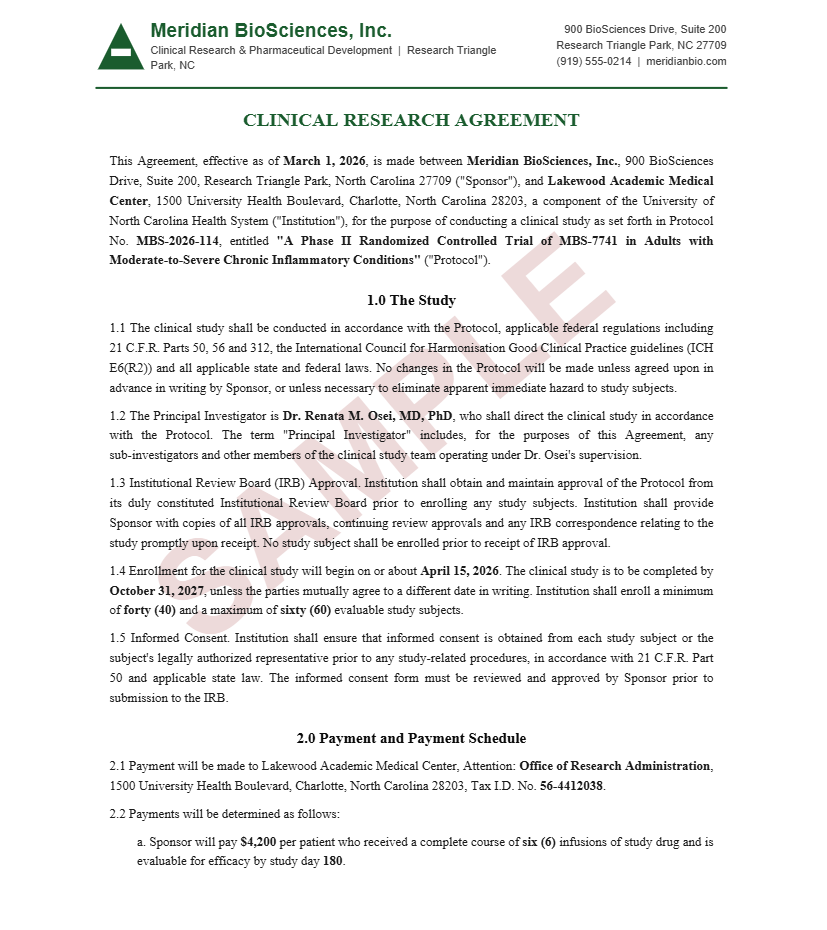
Example of a research and grant agreement:
8. Locum tenens and staffing agency agreements
Credentialing and liability gaps
Locum tenens arrangements introduce temporary providers into clinical operations quickly, often under coverage pressure. The speed of that process creates credentialing risk. A locum who begins seeing patients before primary source verification is complete, or whose privileges have been approved based on the staffing agency's representation rather than independent verification, represents both a patient safety concern and a compliance exposure.
Staffing agency agreements also raise liability questions that standard employment contracts do not. When a temporary provider is placed through an agency, the boundaries of professional liability coverage, the question of who holds the BAA if PHI is accessed and the terms governing scope of practice all depend on how the contract is written. Gaps in any of these areas create exposure that may not surface until an adverse event occurs.
What to watch for:
- Locum arrangements where credentialing documentation was not obtained independently from the agency's file
- Contracts that assume the agency's malpractice coverage is sufficient without confirming limits
- Arrangements where exclusion screening was not completed prior to the provider's start date
Locum agreements should be treated with the same credentialing rigor as permanent provider contracts.
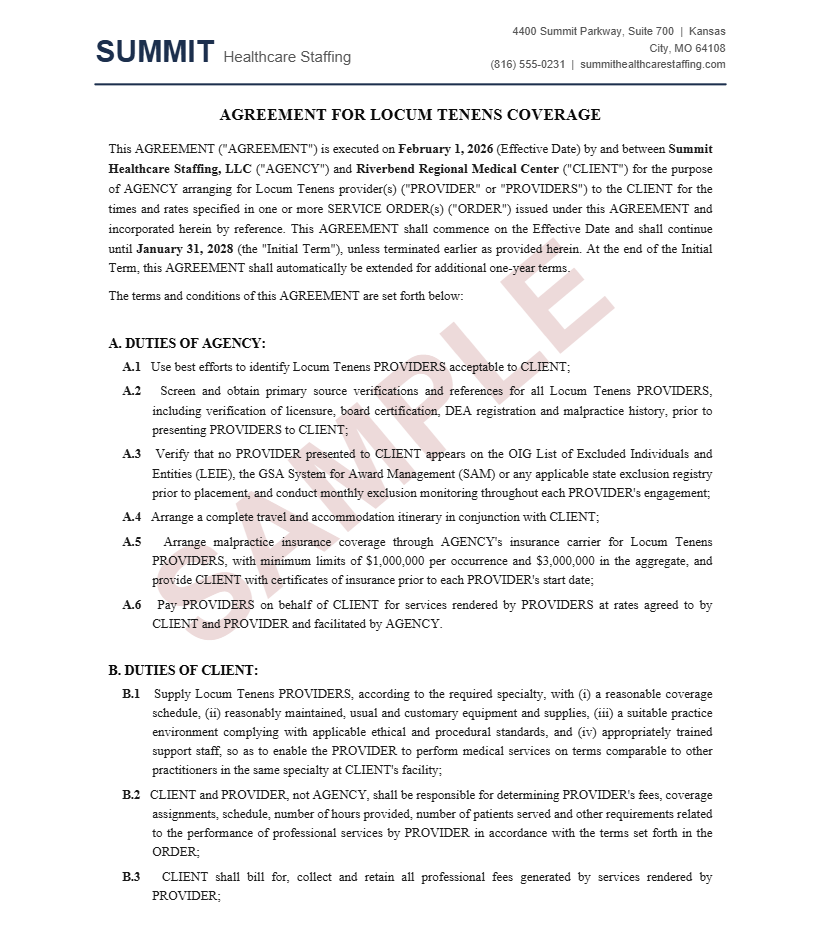
Example of a locum tenens agreement:
No matter how complex the portfolio, implementation doesn’t have to be.
The eight contract types covered here represent some of the most common and compliance-sensitive agreements healthcare organizations manage, but they are far from the complete picture. A mature healthcare contract portfolio spans dozens of agreement types, each carrying its own regulatory obligations, renewal cadences and documentation requirements. Across a mid-size health system, that can mean hundreds of active agreements at any given time, spread across departments, service lines and legal entities that may not always be talking to each other.
What makes that complexity manageable is not reducing the number of contract types or simplifying the regulatory landscape, because neither of those things is possible. What makes it manageable is having a system that treats every contract type with the same level of rigor, surfaces the right information at the right time and keeps compliance and legal teams ahead of their obligations rather than reacting to them. An FMV documentation window closing on a physician lease, a payer contract set to auto-renew without a renegotiation trigger, a vendor BAA that was never updated after a scope of work expansion: these are the details that fall through the cracks in a manual environment and that a well-implemented contract management solution is built to catch.
The organizations that manage contract risk well are not necessarily the ones with the largest teams or the most resources. They are the ones that have given their teams visibility into the full portfolio and the tools to act on what they see. That starts with implementation, and implementation starts with a partner who understands what healthcare organizations are managing day to day.
Here’s what our specialists are saying.
“One of the things I see healthcare organizations underestimate is just how many different contract types, stakeholders, and workflows need to come together in a CLM implementation. At Ntracts, our implementation team works closely with clients to understand those complexities and configure the system in a way that supports their unique processes while also incorporating industry best practices. We don't just focus on getting the technology live, we help organizations think through governance, standardization, and long-term contract management strategies.
A successful implementation creates a foundation that extends far beyond go-live. When clients take the time to align processes and leverage best practices in healthcare contracting, they're better positioned to gain visibility into their agreements, improve compliance, and scale their contract management program as their organization grows. That's where implementation becomes more than a project, it becomes an opportunity to drive meaningful operational improvement.”
Ntracts brings every contract type together.
From physician agreements and payer contracts to BAAs, research agreements and facility leases, healthcare organizations rely on Ntracts to support the full spectrum of contracting needs. Our healthcare-focused implementation team helps organizations configure workflows, strengthen governance and create a foundation for scalable contract management.
Ntracts Contributors
This post features insights from our subject matter experts:
 Rebecca Hayter, CLM Implementation Manager
Rebecca Hayter is the CLM Implementation Manager with expertise in contract lifecycle management, client onboarding and implementation strategy. She partners with organizations to successfully deploy and optimize CLM solutions, helping teams streamline contracting processes, improve compliance and drive operational efficiency. With a focus on collaboration, change management and delivering measurable business value, Rebecca is passionate about helping clients maximize the impact of their contract management technology.