Your vendors now handle more of your patients’ data than you do. Here’s what modern vendor management looks like, and why a signed agreement in a file is no longer enough.
TLDR
- Healthcare vendor management is the process of tracking, evaluating and monitoring the third-party organizations that handle your data, your patients or your operations, and the risk each one carries.
- Vendors are now the primary risk surface. More than 80% of stolen health data comes from third parties, not hospitals, according to the American Hospital Association.
- Signing a business associate agreement and filing it is no longer enough. Oversight is shifting from paperwork to ongoing proof.
- Strong vendor management means one place to see every vendor, every agreement and every risk, for organizations of any size.
What is healthcare vendor management?
Healthcare vendor management is the process of identifying, evaluating and continuously monitoring the third-party organizations a healthcare organization relies on, and managing the compliance and security risk each of those relationships carries. Vendors include billing companies, software services, cloud providers, staffing agencies, medical suppliers, payers and any other outside party that touches an organization’s data, patients or operations.
In healthcare specifically, vendor management is different from other industries because so many of these relationships involve protected health information (PHI). When a vendor creates, receives, maintains or transmits PHI on your behalf, it becomes a business associate under HIPAA, which requires a business associate agreement (BAA) and makes your organization accountable for that vendor’s safeguards. Vendor management is how you keep track of who those vendors are, what they can access and whether they are holding up their end.
Why is vendor oversight so hard in healthcare?
Most healthcare organizations, from a single clinic to a national system, work with far more vendors than they can easily track. Each relationship has its own agreement, its own renewal date, its own risk profile and its own compliance obligations. When that information lives in spreadsheets, shared drives and email chains, no one has a complete picture.
The results are predictable:
- Agreements expire without anyone noticing.
- A BAA is missing and nobody realizes until an auditor asks.
- A vendor lands on a federal exclusion list and keeps getting paid.
None of this happens because teams are careless. It happens because manual tracking cannot keep pace with the number of relationships a modern healthcare organization carries.
Why vendors are now your biggest risk.
The data makes the case plainly. According to the American Hospital Association’s 2025 Cybersecurity Year in Review, more than 80% of stolen protected health information was taken not from hospitals but from third-party vendors, software services, business associates and other outside organizations.* The perimeter most organizations think they are defending is not the one attackers are targeting.
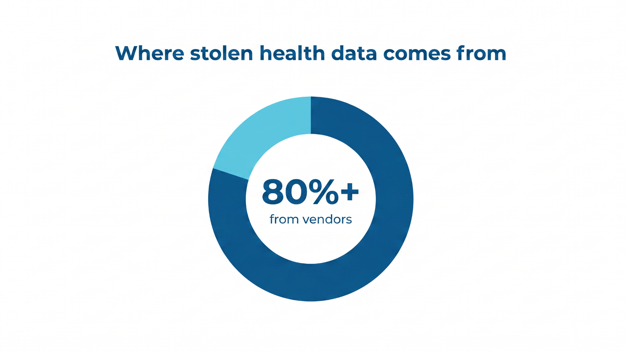 American Hospital Association, 2025 Cybersecurity Year in Review.*
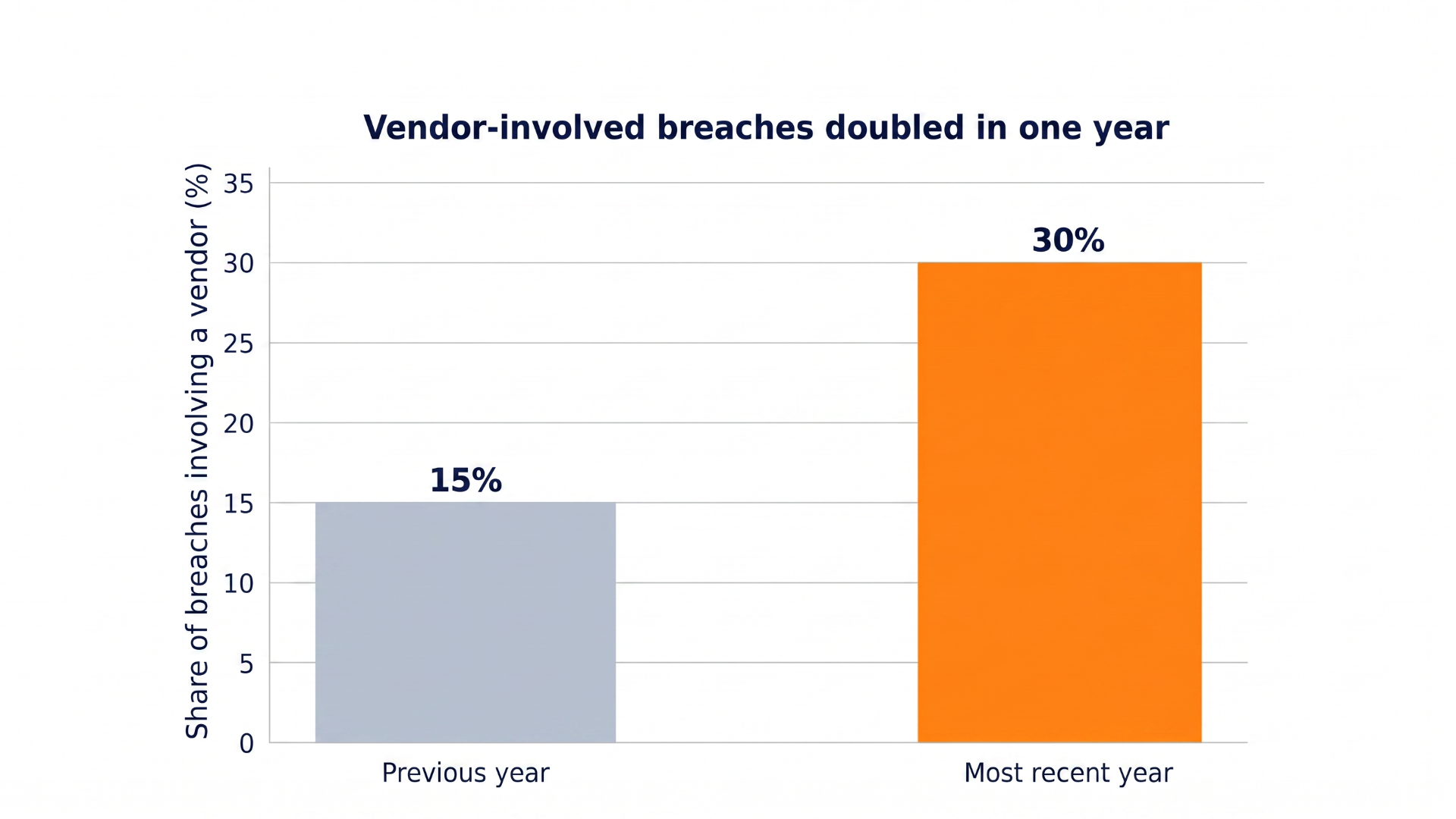
The trend is moving in the wrong direction. Verizon’s 2025 Data Breach Investigations Report found that the share of breaches involving a third party doubled in a single year, from 15% to 30%.** As one report put it, an organization is only as secure as its most vulnerable vendor.
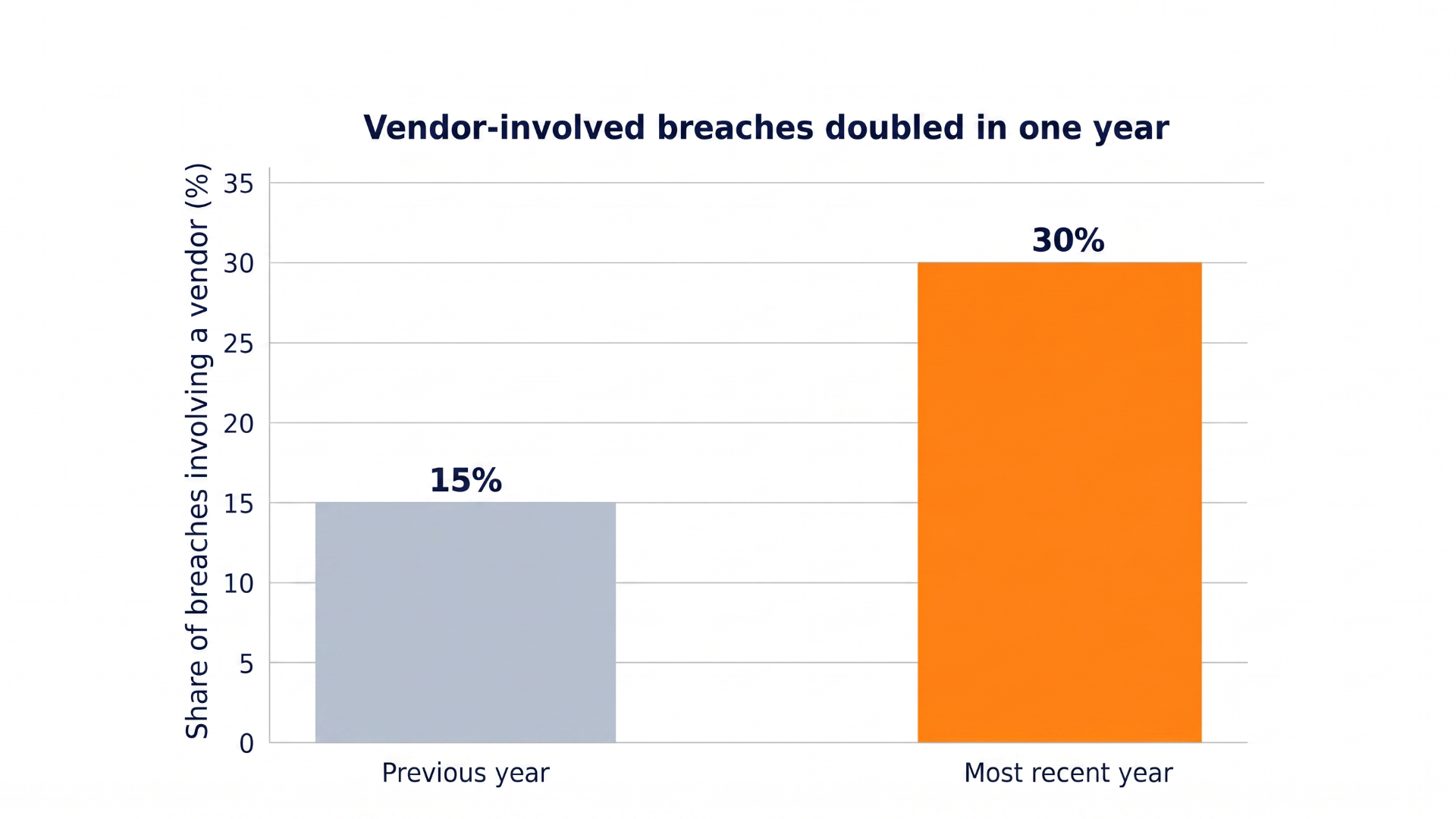 Verizon 2025 Data Breach Investigations Report.**
The shift from paperwork to proof.
For years, vendor oversight in healthcare worked one way: sign a business associate agreement, file it and assume the vendor was handling its obligations. That approach is no longer enough. Regulators, cyber insurers and healthcare organizations themselves are increasingly expecting evidence that a vendor’s safeguards actually exist, not just a signature on file.
This direction is reflected in proposed updates to the HIPAA Security Rule, which would ask organizations to verify their vendors’ safeguards rather than simply hold a signed BAA. Those updates are still proposed and have not been finalized, so no new requirement is in force today. But the direction is clear, and many organizations are already seeing these expectations show up in contract renewals, security questionnaires and vendor reviews regardless of the rule’s status. The organizations getting ahead of it are the ones treating vendor oversight as an ongoing, evidence-based practice rather than a one-time formality.
A signed agreement in a filing cabinet tells you a relationship existed. It does not tell you whether that vendor is a risk today.
What should healthcare vendor management include?
Whether you manage 10 vendors or ten thousand, effective vendor management brings a few core capabilities into one place:
A single source of truth.
Every vendor relationship and every agreement tracked in one system, so you always know who your vendors are and what they can access.
Missing-agreement alerts.
Automatic warnings when a business associate agreement is missing, so a compliance gap surfaces before an auditor finds it.
Risk analysis.
A way to assess and score the level of risk each relationship carries, based on the data a vendor can access and how critical they are to operations.
Exclusion monitoring.
Automated screening that flags vendors appearing on federal or state exclusion lists before they become a liability.
Documented compliance proof.
The ability to request and collect verification directly from vendors, so oversight is evidenced rather than assumed.
The common thread is visibility. When all of this lives in one place, answering a hard question—which vendors are missing a BAA, which are high risk, which have not been reviewed this year—takes minutes instead of a scramble.
What happens when vendor management fails?
The consequences are concrete. A missing or invalid BAA can itself trigger a HIPAA penalty, even if no breach occurs. An excluded vendor left unnoticed can put federal reimbursement at risk. And when a vendor is breached, the fallout lands on the healthcare organization: notification obligations, regulatory scrutiny, financial cost and eroded patient trust. Because a single large vendor often serves many organizations, one vendor’s failure can cascade across dozens of providers at once.
This is not a large-organization problem or a small-organization problem. It affects everyone. A large system has more vendors to track; a small practice has fewer resources to track them with. Both need the same thing: a reliable way to see and manage vendor risk.
How Ntracts approaches healthcare vendor management.
Ntracts brings vendor oversight into one connected solution built specifically for healthcare. Every vendor relationship and agreement lives in one place, with automatic alerts when a business associate agreement is missing.
Built-in risk analysis scores each relationship, and automated exclusion monitoring flags federally or state-excluded vendors before they become a problem. Integrated compliance surveys let you request and document proof directly from vendors, so oversight is evidenced rather than assumed.
Because it connects to the rest of the Ntracts compliance, contract and policy work, vendor management is not a standalone task but part of a complete governance picture.
Frequently asked questions.
What is a business associate agreement (BAA)?
A business associate agreement is a contract required under HIPAA between a healthcare organization and any vendor that creates, receives, maintains or transmits protected health information on its behalf. It defines how the vendor may use and protect that information and establishes each party’s compliance responsibilities. Without a valid BAA, sharing PHI with that vendor is a HIPAA violation.
What is the difference between vendor management and vendor risk management?
Vendor management is the broader practice of tracking and coordinating all of your vendor relationships, agreements, contacts and performance. Vendor risk management is the part focused specifically on identifying and reducing the compliance, security and financial risk each vendor carries. In healthcare, the two are closely linked because so many vendor relationships involve PHI and regulatory obligations.
How often should healthcare vendors be reviewed?
There is no single mandated schedule, but leading practice is to review vendor risk and compliance at least annually, and continuously for higher-risk relationships. Continuous monitoring, such as automated exclusion screening, matters because a vendor’s status can change at any time, not just at contract renewal
.
Why are third-party vendors such a large security risk in healthcare?
Because vendors often hold or access large volumes of PHI and may serve many healthcare organizations at once, they are attractive targets. The American Hospital Association reports that more than 80% of stolen health data now comes from third parties rather than hospitals themselves.*
Sources
*American Hospital Association, 2025 Cybersecurity Year in Review, Part One: Breaches and Defensive Measures (John Riggi and Scott Gee), October 2025.
**Verizon, 2025 Data Breach Investigations Report, April 2025.