
TLDR
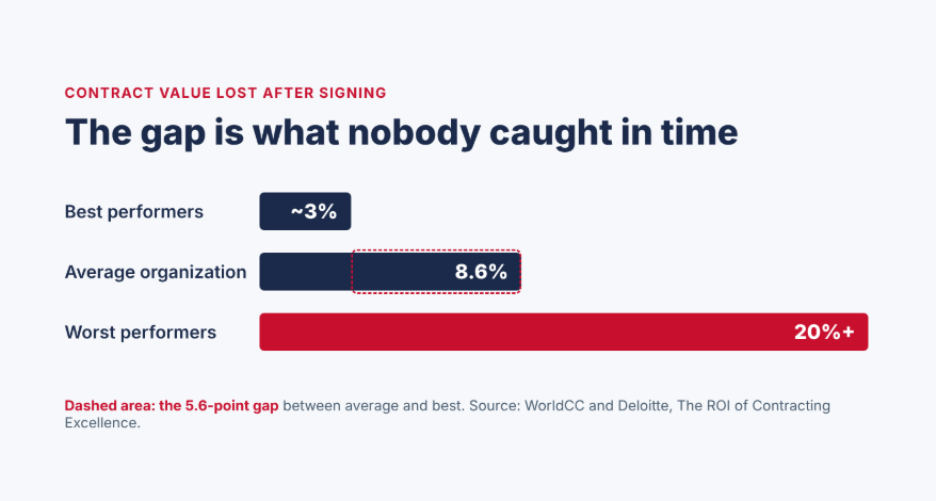
- The average organization loses about 8.6% of contract value after signing, while the best performers hold that loss near 3% (WorldCC and Deloitte).
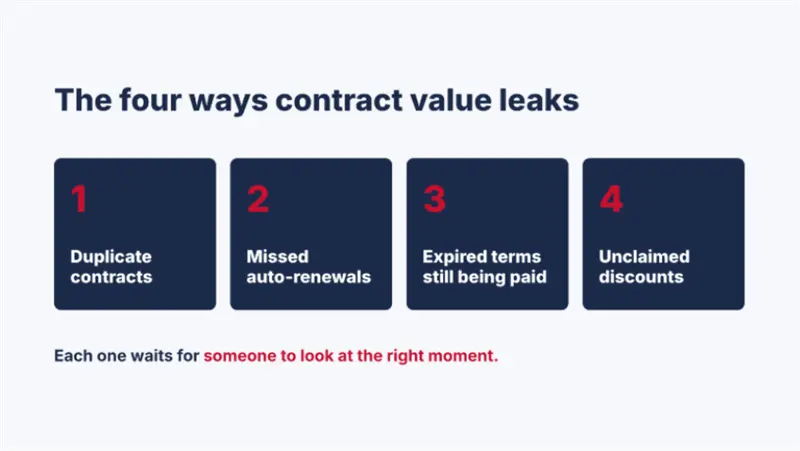
- Most of the gap comes from four leaks: duplicate contracts, missed auto-renewals, expired contracts still being paid and discounts nobody claimed.
- Each one depends on someone looking at the right contract at the right moment, which is why competent teams still miss them.
- The fix is a system that acts on contract terms instead of waiting to be checked.
The gap between 8.6% and 3%
Most organizations don’t lose contract value at the negotiating table. It tends to slip away after signing, a little at a time and usually in places nobody is actively watching, which is exactly why it’s so easy to miss.
World Commerce & Contracting and Deloitte measured how much it adds up to in their study The ROI of Contracting Excellence. They found that the average organization loses about 8.6% of contract value to erosion. The best performers keep that loss to a little over 3%, and the worst lose more than 20%.
That spread gets real quickly when you attach dollars to it. For a health system managing $500 million in contracted spend, the difference between average and best works out to roughly $28 million a year. Getting it back doesn’t require pushing a single vendor harder, because it’s money you already agreed to on paper that simply never made it to the ledger.
So where does it actually go? In most organizations, nearly all of it leaks out in four predictable ways.
1. Duplicates: paying twice for the same thing
Duplicate contracts usually start innocently, when two departments buy the same service from different vendors or from the same vendor under separate agreements. Radiology might sign a maintenance deal on its imaging equipment while facilities signs another that covers much of the same ground. A newly acquired hospital might bring along software licenses for tools the system is already paying for.
In most cases nobody did anything wrong, since each contract made perfect sense to the person who signed it. The trouble is that no one ever had a reason to look at them side by side.
Healthcare is especially prone to this because so much growth happens through acquisitions. Every new facility arrives with its own vendor list, and with everything else that comes with integration, sorting through those lists rarely makes it to the top of anyone’s priorities.
Another round of spreadsheet reviews won’t solve it for long. What helps is a system that compares what you’re about to sign against what you already have. That’s where AI comes in, flagging overlapping services before a second contract ever goes out for signature.
2. Auto-renewals: the date that passed quietly
Most vendor agreements renew automatically unless someone sends notice. That notice window often closes 60 or 90 days before the end date, and it’s usually tucked into a clause nobody has read since the contract was signed.
If the window passes, you’re committed to another term whether you wanted one or not. That can mean the same pricing (sometimes with an escalator built in), the same vendor you were planning to move away from and the same scope even if your team stopped using half of it last year.
IT leaders tend to feel this one the most. When a clinical system renewal surfaces only 30 days out, there’s no realistic way to evaluate alternatives, run a security review or negotiate better terms, so the deadline ends up making the decision for you.
What makes auto-renewals so hard to manage is the sheer volume. Renewal dates are staggered across hundreds of contracts, and each one depends on someone remembering to check at the right time. Calendar reminders can help, but even the best reminder still sits there waiting for a person to act on it, which is where contract workflow automation makes the difference.
AI Clause Search helps you find the contracts that need to be amended or acted on, like auto-renewals, before the date passes.
3. Expired terms still being paid
Sometimes the contract ends but the invoices keep coming. An agreement expires, the vendor keeps billing as usual and accounts payable keeps paying because nothing in their process tells them to stop. Sometimes the work is still happening informally, and sometimes it wrapped up months ago. Either way, money is going out against terms that technically no longer exist.
In healthcare, this becomes a governance problem well before it shows up as a finance one. When a contract expires, the obligations attached to it expire right along with it, including data protection terms, service levels and insurance requirements. For physician arrangements, an expired agreement can also open the door to Stark Law and Anti-Kickback Statute exposure.
That means an expired contract that’s still being paid is more than wasted spend. It’s a working relationship running without any of the protections you originally negotiated.
Catching these early comes down to connecting contract end dates to what’s actually being paid. AI Data Abstraction pulls key terms, such as end dates and renewal terms, straight from the agreement, so those dates are in the system from the moment the contract is.
4. Unclaimed discounts: terms you won and never collected
Supply chain teams put real effort into negotiating volume tiers, rebates and early payment discounts. Then the contract gets signed, filed away and largely forgotten.
The catch is that most of these terms only pay off if someone is paying attention. A rebate tied to a purchase threshold only comes through if someone tracks spend against that threshold. A volume tier only applies once someone lets the vendor know you’ve qualified, and an early payment discount only counts if invoices are paid within the window.
All of it is written plainly in the contract. The people who negotiated those terms have usually moved on to the next deal, though, and the people processing invoices may never have seen them at all.
This might be the most frustrating of the four leaks, because the hard part is already done. Your team won those terms at the table, and the savings are sitting there waiting for someone to claim them.
Why it keeps leaking, even with good people
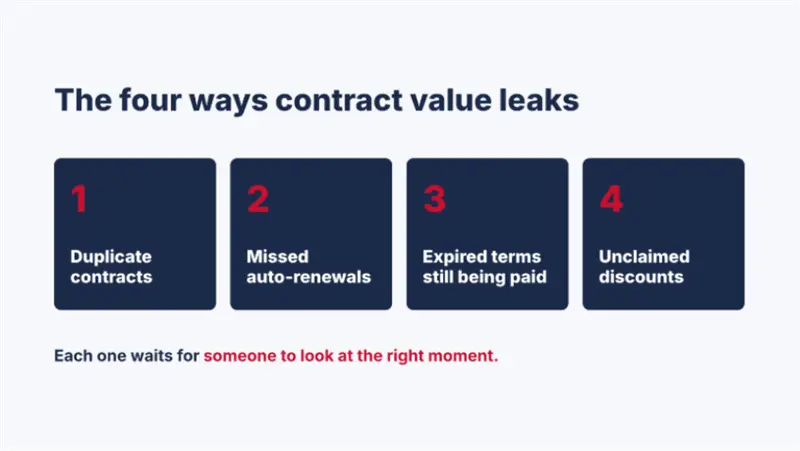
If you look at the four leaks together, a pattern starts to show. Every one of them depends on someone looking at the right contract at exactly the right moment. That might mean spotting a duplicate before signing, catching a renewal window before it closes, connecting an end date to an invoice or tracking a rebate threshold over a full year.
That isn’t a reflection on your team, who are almost certainly capable people doing their jobs well. It’s a reflection of how contracts work. They’re static documents, and the moments that matter are scattered across months and years. Expecting people to watch hundreds of agreements for those moments is really asking them to get lucky over and over again.
This is also why better visibility on its own doesn’t close the gap. A dashboard can show you everything and still sit there until someone opens it. Moving from 8.6% toward 3% takes a system that acts on your contract terms instead of waiting to be checked.
What closing the gap looks like
Closing the gap doesn’t mean renegotiating with every vendor or hiring more people. It means getting the important terms out of the PDF and into a system that actually does something with them. In practice, that tends to look like this:
- Key dates and terms pulled from every agreement automatically, not typed in by hand
- Overlapping services flagged before a new contract is signed
- Renewal and expiration windows that prompt action with enough lead time to make a real decision
- Pricing tiers and rebate terms visible to the people paying invoices
A good place to start is one simple question. If one of your contracts auto-renewed last month, would anyone on your team know about it? If the honest answer is “maybe,” that’s likely where your money is going.
If you’re curious how much of that 8.6% might be sitting in your own contracts, talk with our team about how Ntracts CLM helps healthcare organizations catch it in time.
Sources: WorldCC, Aug 2023 · WorldCC, Jun 2026