TLDR.
- Most healthcare organizations have policies. What they often lack is a reliable system for staff to find the current version when they need it most.
- Working from an outdated or inconsistent policy is a patient safety risk, not just an administrative gap.
- Accreditation surveyors and CMS inspectors don't just verify that policies exist. They require documentation that staff were trained on the current version and understood it.
- The distance between a policy on paper and a policy in practice comes down to ownership, review cycles, documented approvals and confirmed staff acknowledgment.
- Organizations that consistently pass surveys share one infrastructure trait: a single searchable source of truth with automated notifications and audit-ready attestation records.
- Ntracts Policy Manager provides healthcare organizations one searchable, always-current policy library with automated workflows, regulatory monitoring and built-in attestation tracking.
- When was this policy last reviewed, and by whom?
- When this policy was updated, how were staff notified?
- Can you show that staff in this unit read and understood the current version?
- If a regulatory standard changed last quarter, which of your policies were affected, and how quickly were they updated?
It's 2 a.m. A nurse needs your hand hygiene protocol. She searches the shared drive, finds two versions with similar names and picks one.
How confident are you that she found the right one, and that it's current?
For most healthcare organizations, the honest answer is: not very.

The problem isn't that policies don't exist.
Almost every healthcare organization has policies. What they often don't have is a reliable way for the right person to find the right version at the right time.
Policies get written, approved and filed. Then they get updated and re-filed, but the old version stays in the shared drive. Or a department head keeps a printed copy that never got swapped out. Or the intranet page hasn't been touched in two years because no one has edit access. Or a new employee was trained on a version that was superseded six months before she was hired.
None of this is negligence. It's the natural result of managing a living document library without a system built to handle it.
Why this is a patient safety issue, not just a workflow problem.
When staff work from outdated or inconsistent policies, the consequences don't stay administrative.
An infection control protocol that predates a regulatory update. A medication administration policy with conflicting language between two units. A code blue procedure that reflects last year's staffing model. These aren't hypotheticals. They're the kinds of findings that surface in incident reviews and accreditation surveys.
The patient safety risk isn't usually a single wrong policy. It's the cumulative effect of an organization where staff can't trust that what they're reading is current. When the system isn't reliable, people work from memory, from habit or from whatever version happens to be nearby. That's where gaps form.
What surveyors find, and what they're actually looking for.
Accreditation surveyors and CMS inspectors aren't just checking whether policies exist. They're checking whether your organization can demonstrate that policies are current, that staff have been trained on updates and that you have documentation to prove it.
The questions they ask are revealing:
Most organizations can answer the first question. Fewer can answer the rest with anything more than a spreadsheet and a folder of sign-in sheets.
The gap between “we have a policy” and “our policy is working.”
A policy on paper isn't the same as a policy in practice. The distance between those two things is where most organizations are exposed.
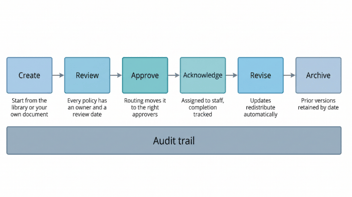
Closing that gap requires more than better filing. It requires a policy program: a system where every policy has a clear owner, a defined review cycle, a documented approval workflow and a way to confirm that the people who need to follow it actually understood it.
That last piece is where most organizations fall short. A signature on an acknowledgment form confirms that someone opened the document. A competency check confirms they understood it. In a survey, the difference between those two things matters.
What a policy program that actually protects you looks like.
Healthcare organizations that consistently pass surveys and maintain strong compliance records tend to share a few things.
Every policy lives in one place, and that place is searchable. Staff don't have to know where to look. They search, find the current version and the system logs the interaction.
When a policy changes, the people who need to know are notified automatically and routed to complete any required training or attestation. There's no manual distribution list, no email thread that gets ignored and no printed memo that disappears.
When a reviewer rejects a draft, the policy goes back to that specific step in the approval workflow, not to the beginning. Review cycles that used to stretch for months get completed on time.
And when a regulatory change occurs, the system flags which policies are affected. The compliance team doesn't find out from a surveyor.
The 2 a.m. test.
Here’s a practical way to assess where your organization stands. Think about what happens when a staff member needs a policy outside business hours.
Can they find it in under two minutes? Is there any question about which version is current? Would a surveyor, looking at that interaction the next morning, see documentation of what was accessed, when and by whom?
If the answer to any of those is no, that’s the gap worth closing. Not because a survey is coming, but because the policies your organization writes exist for a reason. They should be working for your staff, not sitting in a folder somewhere waiting to become a liability.
Ntracts Policy Manager gives healthcare organizations one searchable, always-current home for every policy, with 15,000+ professionally developed, customizable templates, automated regulatory monitoring, step-specific approval workflows and built-in attestation and competency tracking.