TLDR
- More than 95% of U.S. hospitals use a GPO, but that’s not the same as full coverage.
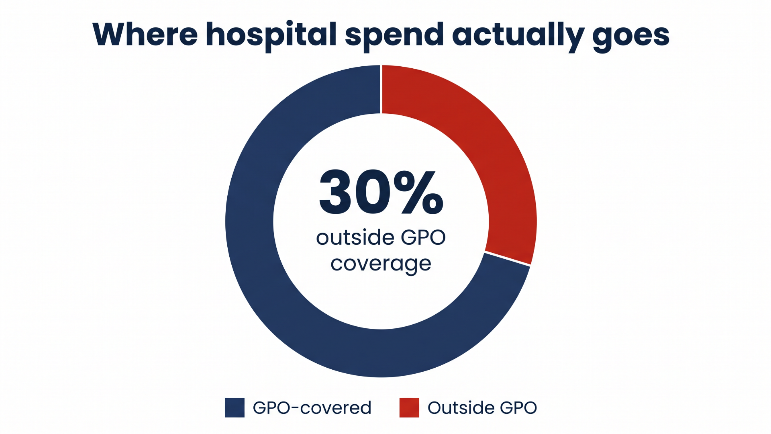
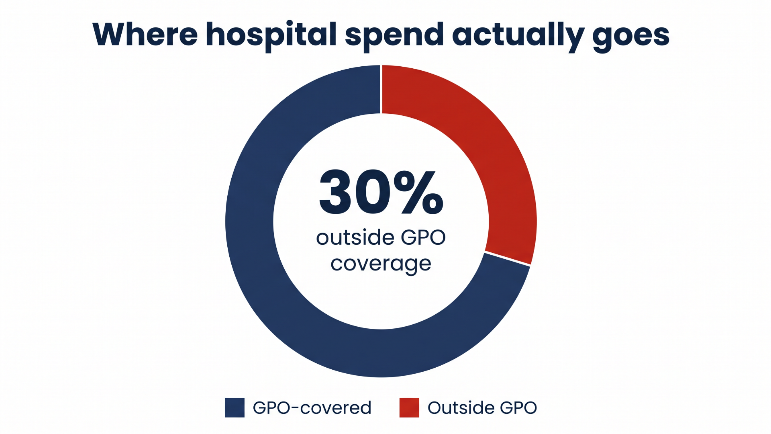
- GPO contracts cover only 60-80% of non-labor spend, leaving 20-40% unmanaged.
- Purchased services, often 20-30% of a hospital’s budget, are the category GPOs cover least.
- Same GPO, different results: membership doesn’t guarantee visibility or governance.
- The fix isn’t leaving your GPO. It’s connecting what it doesn’t cover to one governed system.
Most supply chain teams believe the vendor consolidation problem is already solved.
Ask a supply chain director how well their organization manages vendor spend, and the answer usually starts the same way: "We’re part of a GPO." It’s a reasonable answer. Group purchasing organizations exist specifically to negotiate better pricing and terms than any single hospital could get on its own, and joining one is close to universal practice in healthcare.
That’s exactly why the gap is so easy to miss. GPO membership feels like the vendor spend problem has been handled. In a meaningful number of cases, it hasn’t been, not because the GPO failed at its job, but because its job was never the whole job.
What a GPO covers, and what it doesn’t.
GPOs were built to negotiate the categories where standardization works well across a large membership base: clinical supplies, medical devices and pharmaceuticals. Aggregating hundreds of hospitals’ purchasing volume for a supply item or a drug is a comparatively straightforward problem, and GPOs do it well.
Purchased services are a different category entirely. Equipment maintenance contracts, staffing agreements, waste management, biomedical services, and specialized clinical service arrangements tend to be more customized to each hospital’s specific vendors, equipment and local relationships. That’s much harder to standardize across a GPO’s full membership, and it shows in the numbers: purchased services can represent 20-30% of a hospital’s total budget, and it’s consistently the category with the least GPO coverage and the least internal ownership.
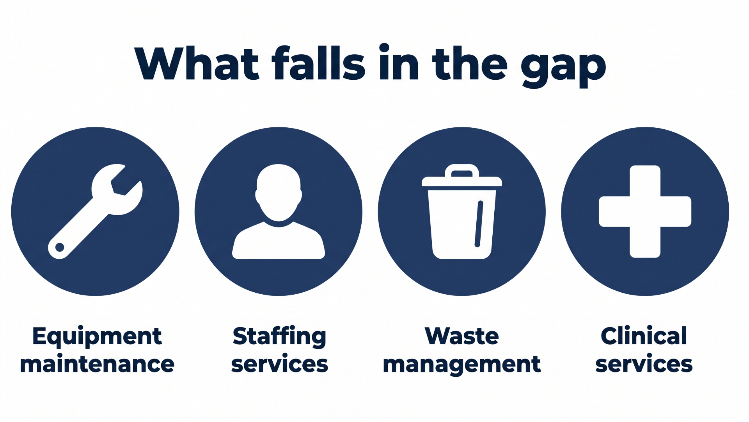
Nobody set out to leave this spend unmanaged. It simply sits in the gap between what the GPO negotiates and what procurement actively tracks day to day, and gaps like that tend to stay invisible until someone goes looking.
The numbers behind the gap.
More than 95% of U.S. hospitals participate in a GPO.* That’s close to universal adoption, and it’s the number that creates the false sense of coverage.
The actual coverage number tells a different story. GPO contracts account for roughly 60-80% of hospital and nursing home non-labor spend, according to Dobson DaVanzo’s widely cited analysis of the group purchasing industry.** That leaves 20-40% of non-labor spend, real dollars, outside any GPO-negotiated agreement.
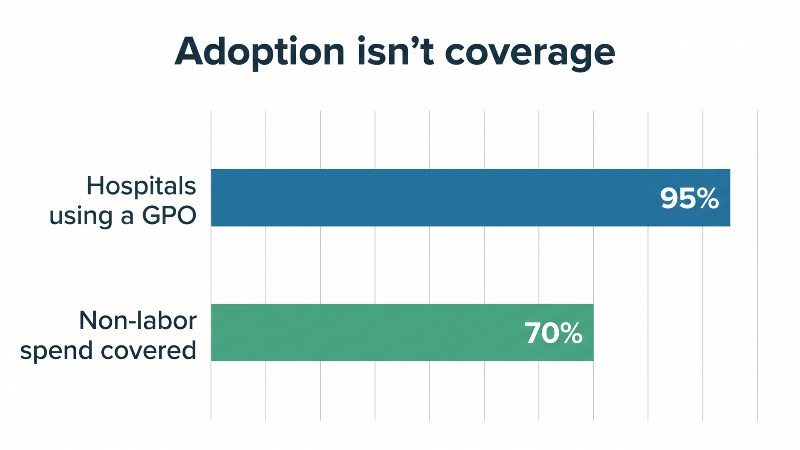
Those two numbers next to each other are the whole point. Adoption is nearly universal. Coverage is not. And the difference between the two is exactly where purchased services spend tends to live, reviewed on a fixed cycle if it’s reviewed at all, with no one systematically checking whether pricing still holds up between renewal dates.
Why GPO membership alone doesn’t guarantee results.
Two hospitals on the identical GPO contract can end up with very different outcomes. A GPO negotiates the ceiling, the best available terms a member can access. It doesn’t enforce which contracts a hospital uses, flag when pricing drifts after signing, or catch spend that never touched the GPO agreement in the first place.
That’s a visibility and governance problem, not a purchasing problem, and it’s one every hospital carries regardless of which GPO it belongs to.
What it costs when nobody’s watching.
The clearest illustration is also the simplest to explain: a contract sets a rate, and nobody checks the actual invoices against it. One organization found it had been billed 12% above its own contracted rate, recoverable money that stayed invisible for as long as no one was comparing what the contract said against what was being paid.***
That’s the sharpest version of the problem, but the same pattern shows up more quietly too. A purchased services contract signed three years ago at a competitive rate is still being paid at that same rate today, with no one checking whether market pricing has shifted, whether usage has changed enough to warrant renegotiation, or whether the vendor is still the best option available.
What closing the gap requires.
Spend analytics tools can flag price variance and off-contract purchasing patterns, and for some organizations that’s a genuine improvement over nothing. But a standalone analytics tool answers a narrower question than the one that matters. Knowing you’re overpaying is not the same as having the contract, the vendor relationship, and the compliance context connected in one place.
The 20-40% of spend sitting outside GPO coverage is still governed by real contracts, with real terms, real renewal dates, and in healthcare, often real compliance implications tied to vendor relationships. Treating that spend as a separate problem from the rest of contract governance is how it ends up unmanaged in the first place.
How Ntracts approaches the gap your GPO doesn’t cover.
Ntracts brings purchased services and vendor contracts into the same connected solution as the rest of an organization’s governance, not a standalone spend-analytics tool working in isolation. Contract terms, renewal dates and vendor relationships live alongside compliance and policy obligations, so the spend your GPO was never built to cover doesn’t have to sit unmanaged just because it falls outside a negotiated agreement.
That’s what turns a hidden gap into a tracked one, before it becomes a finding, an overbilled invoice or a renewal nobody meant to let through.

Sources
*Industry reporting on GPO adoption rates among U.S. hospitals, 2026.
**Dobson DaVanzo & Associates, analysis of group purchasing organization impact on hospital and nursing home non-labor spending, as cited in industry reporting on healthcare GPO utilization, 2019.
***Illustrative case example of contract-to-invoice price variance, procurement analytics industry reporting, 2026.

.png?width=807&height=520&name=clm-brochure2%20(1).png)