TLDR
- Evaluating enterprise healthcare CLM software means testing whether it can hold up across distinct legal entities, facility-specific approval chains and role-based access, not just whether it stores and routes contracts well for one team.
- Getting this wrong doesn't just slow a rollout down. Small inconsistencies in templates and approvals at each facility compound into real financial and compliance exposure across the whole system.
- Entity-level segmentation, system-wide reporting and role-based access controls are what separate a solution built for the enterprise from one that simply has more storage.
- A phased implementation, moving through discovery, configuration and training in structured stages, is what keeps a rollout realistic across dozens of departments.
Evaluating Contract Lifecycle Management (CLM) software at the enterprise level means testing whether a solution can support distinct legal entities, facility-specific approval chains and role-based access across dozens of departments, not simply whether it can store and route contracts well. A single-department buyer is asking whether a solution fits one team's workflow. An enterprise buyer is asking whether it can hold up across an entire organization's structure, including its entities, its facilities and everyone who touches a contract along the way.
That distinction sounds procedural, but it's the difference between a solution that works and one that only looks like it works in a demo. A CLM solution built around one department's needs can appear complete right up until a second facility, a third legal entity or a fourth approval chain gets added to it, at which point the gaps in its design start to show.

One system, many entities.
Picture a typical enterprise health system. There's a parent organization at the top, and underneath it sit multiple legal entities, each with its own facilities, its own leadership and often its own way of doing things built up over years, sometimes inherited through an acquisition that never fully integrated its contracting practices with the rest of the system.
Software built for that structure has to do several things at once. A contract signed under one hospital's legal entity needs to stay attributed to that entity, carrying its own numbering and its own signatory authority, while still living inside the same connected system as every other entity's agreements. A facility-level administrator should be able to see and manage the contracts relevant to their own facility without being able to see or edit another facility's agreements, while someone at the system level needs to see across all of them simultaneously. And a contract template or approval workflow ought to behave the same way whether it's used at the flagship hospital or at a facility that joined the organization two years ago and never quite adopted the parent organization's processes.
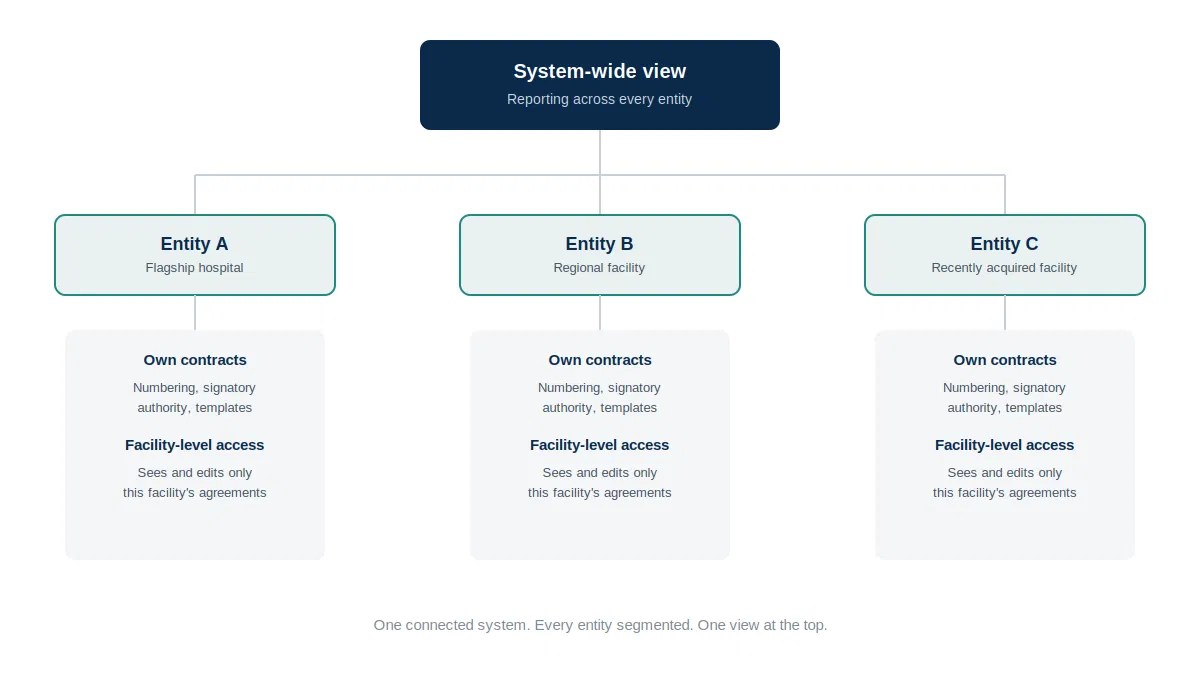
A CLM solution that handles this well for one entity and then simply repeats that same setup for every additional one isn't actually built for the enterprise. It's built for a single facility that happens to have more users attached to it.
Where the cost shows up.
When a CLM solution doesn't account for entity segmentation and facility-level standardization from the outset, the cost isn't only a slower rollout. It's inconsistency that compounds every single time a new contract gets drafted somewhere in the system.
Imagine two facilities within the same health system, each negotiating a similar vendor agreement using a different template, with different approval steps and different language around termination and liability. Neither facility did anything wrong in isolation. But multiply that small drift across dozens of facilities and legal can no longer answer a simple question, such as “which vendor agreements include a particular indemnification clause,” without manually reviewing contracts one at a time. A compliance review that runs reliably at one facility gets skipped entirely at another because nobody standardized the workflow that's supposed to trigger it. And purchasing power that a merger or acquisition should have consolidated stays fragmented instead, spread across entities that never fully integrated their contracting practices, which an HFMA-cited study on hospital merger integration identified as one of the most common reasons projected financial synergies fall short.*
A missed clause or a skipped review at a single facility is a local problem. The same gap, repeated across dozens of facilities, is a systemic one, and it tends to surface at the worst possible moment, whether that's an audit, a merger review or a regulatory inquiry that assumes the organization operates as one entity even when its contracting practices never actually did.
What to look for: entity-level segmentation, system-wide reporting and role-based access.
Strip away the marketing language and an enterprise-ready CLM solution really comes down to three things working together.
The first is entity-level segmentation, keeping contracts, templates and approval chains properly attributed to the correct legal entity while still remaining visible within one connected system, rather than forcing the organization to choose between separation and visibility.
The second is system-wide reporting, giving leadership the ability to answer questions across every facility and entity at once, such as which contracts are expiring next quarter or which vendor agreements still lack a signed business associate agreement, without compiling the answer manually from several disconnected systems.
The third is role-based access, giving each function that touches a contract, whether that's legal, compliance, finance or another team entirely, its own appropriate view rather than one blanket level of access for everyone in the system. What one team needs to see and edit is rarely what another team needs, and a solution built for the enterprise should reflect that difference by default rather than treating access as an afterthought.
None of these three capabilities does much on its own. Together, they're what allow a health system to standardize its contracting practices across facilities without flattening every facility into an identical process that ignores real operational differences between them.
Questions to ask vendors about multi-facility and multi-entity support.
The hardest part of an enterprise CLM evaluation usually isn't the demo. It's telling apart a vendor who has genuinely solved for multi-entity structure from one who's describing a single-facility solution with a bigger number attached.
A few questions worth asking directly:
- How does a contract stay tied to the correct legal entity while still surfacing in a shared, system-wide view?
- A vendor who has solved this can describe the mechanism specifically, not just say "reporting is available."
- What happens when a newly acquired facility needs to join the system?
- A vendor with real multi-entity experience can walk through how that facility gets folded into the existing setup without triggering a separate implementation from zero, because that scenario has almost certainly come up before.
- Where can a standardized template flex for a facility's genuine operational differences, and where shouldn't it?
A vendor who's actually built for the enterprise can talk plainly about that tension, rather than promising that standardization and flexibility never come into conflict.
Vendors who can't answer these in specific, structural detail are usually describing a solution that was built for one department and has since been resized, not one that was built with the enterprise in mind from the start.
What a phased implementation actually looks like at this scale.
Enterprise buyers are often skeptical of implementation timelines, and reasonably so. Industry data on enterprise CLM deployments generally points to a range of three to twelve months or more, depending on the number of contract types, integrations and legal entities involved, and a rollout across dozens of departments and multiple entities can understandably sound like it belongs at the longer end of that range.
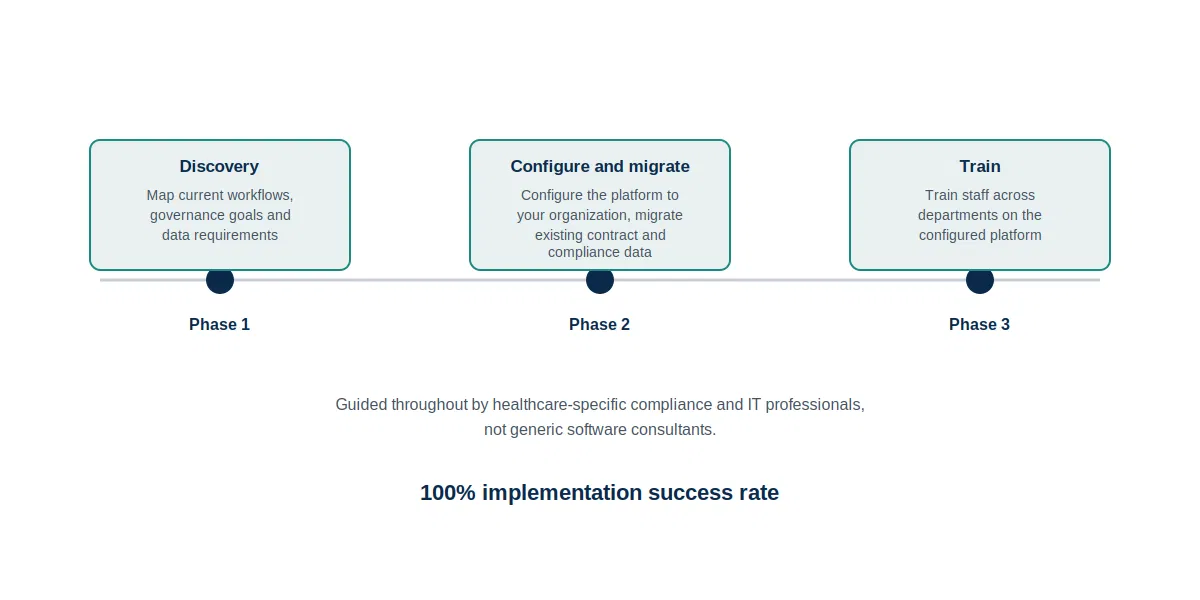
A phased approach is what keeps a timeline realistic instead of aspirational. A well-structured implementation typically moves through a few distinct stages: a discovery phase that maps current workflows, governance goals and data requirements before any configuration begins, followed by configuring the platform to the organization's specific structure and migrating existing contract and compliance data, and finally training staff across departments on the system they'll actually be using.
Skipping or rushing the discovery stage is one of the more common reasons enterprise rollouts stretch out or stall, since decisions made without a clear map of the organization's entities and workflows tend to need revisiting later.
That structure matters even more for a multi-entity buyer than a single-department one, since the discovery work done for the first entity does not have to be repeated from zero for every facility that follows. Additional entities and facilities can be configured against a foundation that already exists rather than triggering a fresh implementation each time, which is what keeps a multi-facility rollout from turning into a series of unrelated projects running on separate timelines.
This is where Ntracts' own track record is worth putting a number on. Every Ntracts implementation is guided by healthcare-specific compliance and IT professionals who understand contracting, compliance and privacy standards like Stark Law, the Anti-Kickback Statute (AKS) and HIPAA, not generic software consultants working from a template built for a different industry. Its implementations reach go-live and measurable value roughly three times faster than the industry average,** a result reflected in a 100% implementation success rate. A discovery-first approach doesn't just protect a timeline, it's what an enterprise health system should expect a phased rollout to deliver.

Sources
*HFMA-cited research via Symmetric Health Solutions, "Hospital Mergers: Solving the Day 1 Item Master Data Problem."
**Ntracts, based on its own implementation data.

.png?width=250&height=161&name=clm-brochure2%20(1).png)