TLDR.
- Healthcare buyers are searching for CLM software that can build vendor performance scorecards.
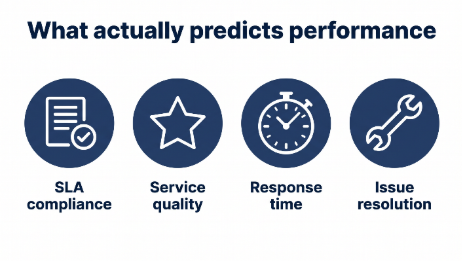
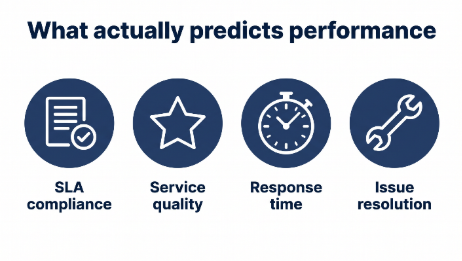
- The metrics that matter go beyond price: SLA compliance, service quality, response time, issue resolution.
- Most scorecards fail for one reason: they’re disconnected from the contract they’re supposed to measure.
- A scorecard not tied to the actual contract terms measures an opinion, not a fact.
- In healthcare, a missed service level can touch patient care, not just budget.
- A staffing vendor that consistently under-delivers affects clinical coverage.
- An equipment maintenance vendor that’s slow to respond affects device uptime that patient care depends on.
- A vendor obligation tied to compliance requirements that quietly lapses becomes a finding, not just a performance note.
A contract says what a vendor should deliver. A scorecard should show whether that’s what’s actually happening.
Every vendor contract makes a set of promises: a response time, a service level, a delivery standard, a quality threshold. Signing that contract is the easy part. Knowing, on an ongoing basis, whether the vendor is meeting it is where most organizations quietly lose the thread.
That gap shows up in what people are searching for right now. Healthcare buyers evaluating contract management software are specifically asking which CLM software can build vendor performance scorecards, not just store contracts or track renewal dates. That’s a meaningful signal. It means the scorecard isn’t a nice-to-have feature request. It’s something teams already know they’re missing.
What a real vendor performance scorecard measures.
Price is the easiest thing to track and often the least useful measure of whether a vendor relationship is working. The metrics that predict whether a vendor is delivering what they promised look different: SLA compliance, service quality, response time to issues and how consistently problems get resolved once they’re raised.*
For purchased services specifically, equipment maintenance, staffing services, environmental services and similar categories, these operational metrics matter more than the negotiated rate, because a vendor that’s cheap but consistently slow to respond or inconsistent in quality can cost far more in disruption than the contract ever saved in price.
The trick isn’t tracking everything. Trying to monitor dozens of metrics dilutes attention until none of them get watched closely.** A handful of KPIs, tied directly to what the contract promises, is what holds up over time.
Why most scorecards quietly stop working.
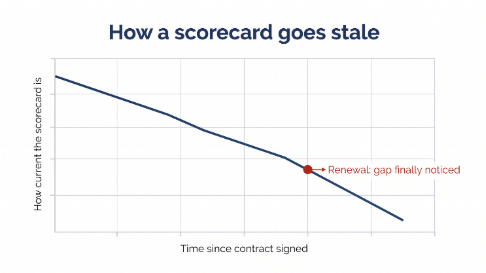
A vendor scorecard usually starts with good intentions. Someone builds a spreadsheet, defines a few metrics and reviews it around contract signing or the first renewal. Then time passes, staff turn over, and the spreadsheet stops getting updated, not because anyone decided performance tracking wasn’t valuable, but because it was never connected to anything that would keep it current.
This is the same pattern that shows up across contract governance generally. More healthcare organizations continue to manage contracts through spreadsheets and shared drives than most people would guess, and that approach exposes them to poor visibility into renewals, compliance and performance all at once.*** A scorecard built on top of that same disconnected foundation inherits the same fragility.
The result is a scorecard that technically exists but doesn’t reflect reality. It shows whatever was true when someone last updated it, which is often months before a renewal decision gets made.
Why disconnection is the real problem, not the scorecard itself.
A scorecard is only as good as its connection to the contract it’s measuring. If the SLA terms live in the executed agreement and the performance data lives in a separate spreadsheet that someone updates manually, the two will drift apart, and nobody will notice until a renewal forces a side-by-side comparison that should have been happening continuously.
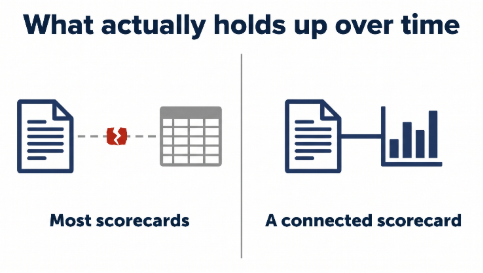
The fix isn’t a better spreadsheet template. It’s removing the gap between where the contract terms live and where performance gets tracked, so a scorecard reflects the actual negotiated SLA, not a generic KPI list built independently of what was signed.
What this means in healthcare specifically.
In most industries, a missed service level is a business inconvenience. In healthcare, the stakes are often higher:
That’s what makes disconnected, stale scorecards a bigger risk in healthcare than in a typical commercial procurement function. The consequences of not noticing drift aren’t just financial.
What a connected scorecard looks like.
A vendor performance scorecard that holds up over time has a few specific properties. It’s built directly from the contract’s own SLA and service terms, not a separate list someone drafted from memory. It updates as performance data comes in, rather than waiting for a scheduled review to catch up. And when a vendor’s performance starts drifting from what they committed to, it surfaces early enough to act on, well before a renewal date forces the conversation.
That’s the difference between a scorecard that’s a periodic exercise and one that’s a continuous, reliable signal.
How Ntracts approaches vendor performance.
Ntracts connects vendor performance tracking directly to the contract that defines it, so a scorecard reflects the actual negotiated terms, not a static list maintained separately from the agreement itself. Because contract data, compliance obligations and vendor performance live in one connected solution, drift between what was promised and what’s being delivered surfaces as it happens, not at the next scheduled review.
That’s what turns a vendor scorecard from a once-a-year exercise into an ongoing, defensible record of whether every vendor relationship is delivering what it promised.
[CTA] See How It Works
Sources
*Industry reporting on healthcare vendor performance metrics and purchased services benchmarking, 2026.
**Industry reporting on contract and vendor performance measurement frameworks in regulated industries, 2026.
***Industry reporting on healthcare procurement technology adoption and contract management practices, 2026.