
TLDR
- A five percent raise for a specialty group sounds like a one-line answer, but calculating its true cost pulls data from contracts, productivity systems, call pay tracking and payroll that were never built to talk to each other.
- Physician compensation rarely lives in one figure. Base salary, wRVU productivity payments, call stipends and quality incentives are usually tracked in separate systems, each with its own version of the truth.
- Getting an accurate number usually means finance, medical staff services and department chairs trading spreadsheets back and forth for days or weeks, reconciling versions as they go.
- The same fragmentation that slows down a compensation question shows up in healthcare contract management more broadly, where terms, renewal dates and financial obligations live in disconnected systems across departments.
- A single source of truth turns a multi week research project into a same day answer.

The question that sounds simple.
A board member asks, "What would a five percent raise for the cardiology group cost the organization next year?"
It sounds like the kind of question that should have a quick answer, maybe even one someone could produce during the meeting itself. Instead, the CFO says the team will need a couple of weeks to get back with a number.
That gap between a simple question and a complicated answer has nothing to do with competence. It has everything to do with where the underlying data lives and how many places someone has to check before anyone can trust the total.
Boards ask versions of this question often. What would it cost to bring orthopedic surgery pay in line with a regional benchmark? What would happen to the compensation pool if call stipends increased across every specialty that takes unassigned call? Each question sounds like it should take minutes. Each one instead becomes a project with its own timeline, because physician compensation is rarely one number sitting in one place.
Where the answer actually lives.
Physician compensation touches more systems than most board members realize. To calculate the true cost of even one percentage point of increase, someone typically has to pull information from several places that were never designed to share data with each other.
- Physician contracts hold the base salary figures, productivity formulas and incentive terms negotiated at the time of hire or renewal, often stored as executed documents rather than structured data.
- Productivity systems track wRVU output by physician and by month, information that determines how much of total compensation shifts with a base pay increase.
- Call pay tracking, frequently maintained on its own spreadsheet by medical staff services or the department chair's office instead of dedicated physician time tracking software, holds stipend rates and coverage schedules by specialty.
- Payroll systems hold what physicians are being paid today, which does not always match the terms in the underlying contract if amendments were never fully reflected downstream.
- Which employment agreements are up for renewal in the next ninety days?
- How many contracts still reference a compensation formula that was updated in practice but never formally amended?
- Which call coverage agreements have terms that no longer match what physicians are actually being paid?
Each of these systems holds its own version of the truth, updated on its own schedule, by different teams, for different purposes. None of them were built with the others in mind, and none of them were designed to answer a board level question on its own. Most organizations are still stitching this together by hand, because true physician compensation software that connects all four pieces is rare. The information all exists somewhere. It just doesn't exist in one place, in one format, at one point in time.
Why weeks, not days?
Once someone starts pulling numbers from these separate sources, the real work begins: reconciling them. A productivity report might reflect wRVU output through last month, while the contract on file reflects a compensation formula that was amended six months ago and never fully updated in the system tracking it. A call pay spreadsheet might use different specialty groupings than the ones finance uses for budgeting. Version control becomes its own project as documents circulate between finance, medical staff services and department chairs, each adding corrections that need to be checked against everyone else's.
This back and forth is where days turn into weeks. The math itself is not hard. Multiplying a base salary by five percent takes seconds. What takes time is confirming which base salary is current, which physicians the increase actually applies to, and whether any of them have productivity or incentive terms that would shift the total in ways a flat percentage does not capture.
Every round of email or every meeting to reconcile a discrepancy adds a day. Every specialty group that has its own compensation structure adds another layer of checking. None of this shows up as a single obvious bottleneck. It shows up as a steady accumulation of small delays, each reasonable on its own, that together turn a same day question into a multi week answer.
The real cost behind the number.
Even after the data gets reconciled, the sticker figure on a five percent raise is not the full cost. If any portion of compensation is tied to wRVU productivity, a base pay increase can change how that formula performs relative to benchmark, which matters for fair market value documentation. Call stipends do not always move with base pay, but boards often want to know whether they should, which means someone has to model that scenario separately rather than assume it follows the same percentage.
Then there are effects that never show up in a spreadsheet formula. Raising base pay for one specialty can create internal comparisons across other specialties that were not part of the original question, particularly if compensation committees or medical staff have visibility into relative pay. Fair market value and commercial reasonableness considerations sit underneath every physician compensation change, which is why physician compensation compliance is not something finance checks after the fact. It has to be built into the number from the start.
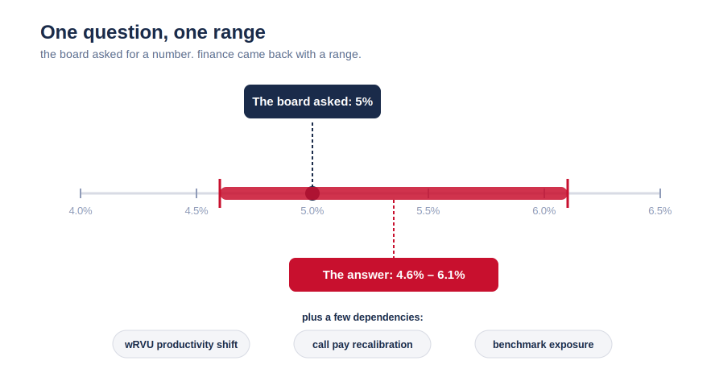
By the time all of this gets factored in, a straightforward sounding board question often comes back with a range rather than a single number, along with caveats about what could move that range in either direction.
The same fragmentation shows up in contracts.
This pattern is familiar to anyone who has spent time in physician contract management and tried to answer a seemingly simple question about physician contracts more broadly:
The answer to each of those questions usually lives in the same kind of scattered, department-by-department state that compensation data does. Contract terms sit in file folders or shared drives, productivity and call pay data get tracked separately by whoever owns those spreadsheets, and the connections between what a contract says and what a physician is actually paid often exist only in someone's memory. Getting a reliable answer means the same reconciliation work a compensation question requires, multiplied across every physician contract the organization holds.
This is the problem Ntracts' healthcare contract lifecycle management solutions are built to solve. Ntracts gives healthcare organizations a single, searchable source of truth for every physician contract, structured against the actual compensation terms rather than buried in a static document, so finance, medical staff services and department leaders are working from the same information. When the underlying data already lives in one place, a board question does not have to trigger a multi-week research project. It can get answered the same day someone asks it.
See how Ntracts brings physician contracts into a single source of truth.