What responsible AI looks like in daily healthcare contract work.
Healthcare organizations don’t need faster contract search.
They need intelligence built for the real work of healthcare contracts.
AI for healthcare contract management must operate differently. In healthcare contract lifecycle management, the margin for error is small and the impact of being wrong is real. Provider compensation, reimbursement structures, vendor relationships, renewal terms, audit rights and compliance obligations represent areas of highest spend and greatest exposure. In these environments, almost right isn’t right enough.
That’s why AI for healthcare contracts can’t be occasional or reactive. It has to support a disciplined routine that runs continuously across the contract lifecycle.

Every effective routine begins with clean contract data.
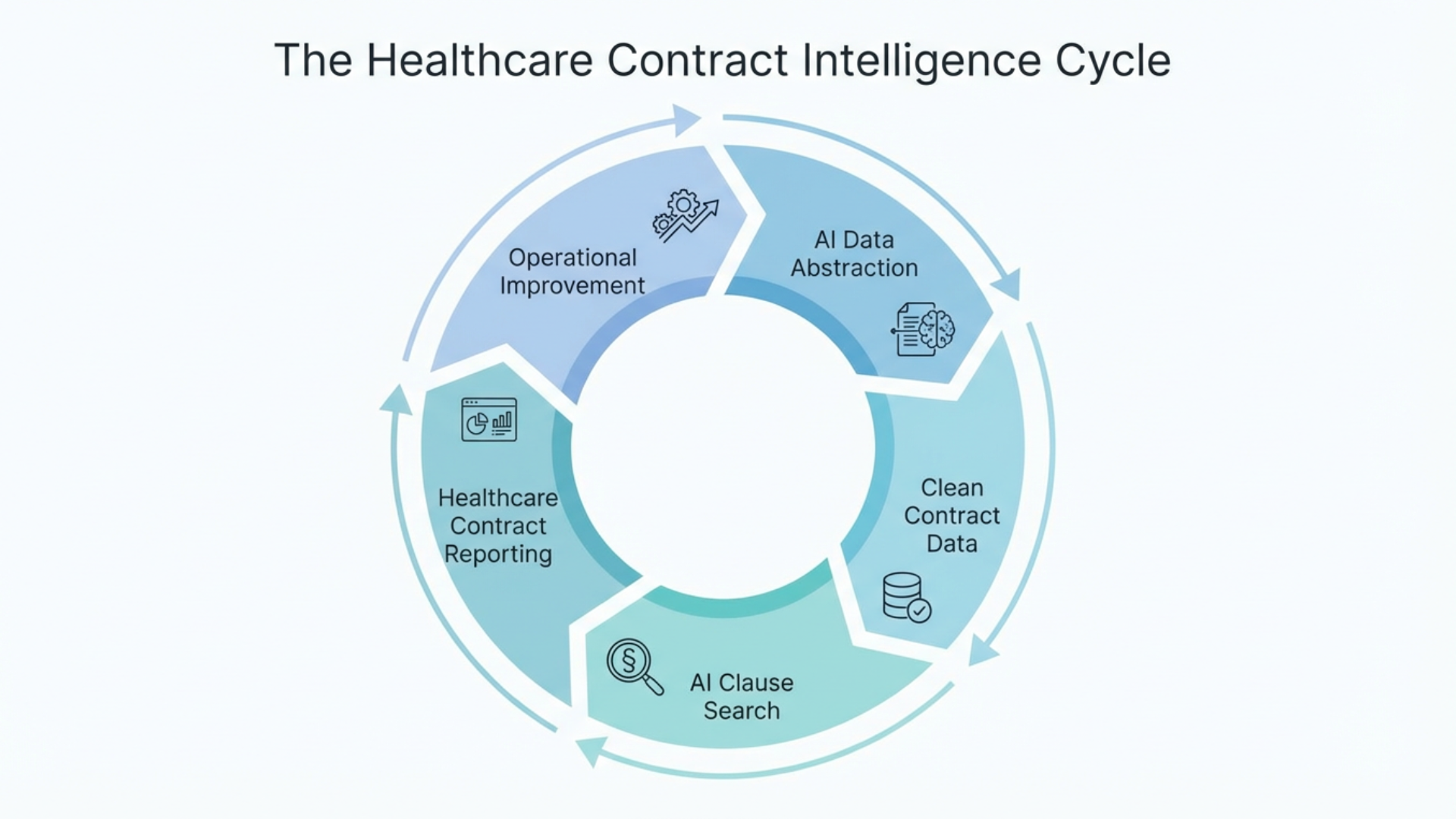
Healthcare contract intelligence starts with structure. AI data abstraction improves the quality and consistency of healthcare contract data from the start. Instead of relying on unstructured text buried in lengthy agreements, clauses are captured with context and conditions intact.
Without structured data, AI can only find words.
With clean contract data, AI can understand what those words mean, how they apply and when they matter.
In a routine, this isn’t a one-time exercise. Data quality is maintained as contracts are created, renewed and amended. Structure becomes the foundation for everything that follows.
In a disciplined routine, search is proactive, not reactive.
Healthcare contract teams aren’t searching casually. They’re looking for answers tied to compensation exposure, reimbursement differences, renewal risk, audit obligations and compliance-linked clauses. In many organizations, those searches happen under pressure.
When contract data is structured correctly, AI clause search becomes part of an ongoing rhythm. Teams can routinely review renewal timelines, monitor reimbursement language across payers and identify agreements with restrictive audit or termination terms. Search shifts from scrambling for answers to proactively identifying exposure.
Whether an organization manages dozens of agreements or thousands across an enterprise health system, that proactive rhythm reduces manual review and improves oversight.
Reporting is how the routine drives performance.
Search provides answers. Reporting sustains accountability.
When clause data is captured consistently, healthcare contract reporting reveals trends across the contract lifecycle. Renewal exposure can be monitored over time. Reimbursement variance can be compared across payers. Audit response windows can be tracked before they become urgent. Compliance obligations can be aligned with operational workflows.
In the routine, reporting is not a dashboard someone checks once. It’s how leaders measure cost control, execution discipline and risk management across healthcare contract lifecycle management.
This is the point where AI shifts from helpful to essential.
Leaders don’t just want answers. They want clarity they can act on. Through structured healthcare contract data, AI clause search and disciplined reporting, organizations can reduce cost leakage, improve execution and manage risk more effectively.
Responsible healthcare contract intelligence doesn’t replace professional judgment. It strengthens it. Human expertise remains central to healthcare contract management. AI supports contract, compliance and legal teams by surfacing the right information at the right time, so decisions remain informed, accountable and grounded in context.
Intelligence compounds when the routine repeats.
As healthcare contract data becomes cleaner, AI performance improves. Improved clause search strengthens reporting. Stronger reporting leads to more confident decisions. And more confident decisions make contract oversight more disciplined over time.
That is the healthcare contract intelligence routine.
It isn’t about speed alone. It’s about building structured, healthcare-specific intelligence that supports cost control, operational execution and risk management over time.
Responsible AI in healthcare contract management doesn’t promise shortcuts. It supports better oversight, clearer visibility and more confident decisions across the contract lifecycle.
If you’re exploring AI for healthcare contracts, AI clause search or healthcare contract reporting software, the question isn’t whether AI can retrieve language from a document. It’s whether that AI is built for the complexity, regulation and financial exposure unique to healthcare.
When accuracy isn’t optional, neither is the intelligence behind your contracts.