
What ‘ready for contract management software’ actually looks like, and how to know if you’re there.
TLDR
- Most healthcare organizations assume contract management software is built for large health systems, but it’s not anymore.
- The signs that your current approach isn’t scaling are specific and recognizable, and most organizations hit them before they realize it.
- Ntracts’ new CLM Flex is built for the space between spreadsheets and enterprise: structured, pre-configured and fast to value for smaller healthcare organizations.
- You don’t need to grow into it because it’s sized for where you are today.
There’s a story that runs through most healthcare organizations managing contracts without dedicated software:
A vendor agreement expires. Not because nobody knew about it. In fact, somebody had it on a spreadsheet.
But the spreadsheet was on someone’s local drive, and the person who managed it left eight months ago, and the version that got passed around was the one from two renewals back.
By the time anyone noticed, the contract had auto renewed on terms that hadn’t been reviewed in three years.
Nobody made a mistake, the system just wasn’t built for the moment it needed to catch something.
This isn’t a story about enterprise health systems. It’s the story of the community hospital, the FQHC, the growing specialty network. The organizations where one person manages contracts alongside five other responsibilities and where the system is whatever combination of shared drives, spreadsheets and email threads has worked well enough until now.
The assumption most of these organizations carry is that they’re not ready for contract management software. That Contract Lifecycle Management (CLM) is for the big systems. That moving to something structured requires budget they don’t have, implementation timelines they can’t absorb and complexity they don’t need.
That assumption is worth questioning. The threshold for being CLM ready is lower than most people think, and the cost of staying with the current system is higher than it looks.
The false choice that keeps organizations stuck.
Healthcare organizations looking at contract management tend to encounter two options:
- The manual processes that have gotten them this far
- Enterprise CLM software built for health systems with dedicated legal teams, IT resources and large implementation budgets.
The first option has real costs. The second is often a poor fit. Enterprise CLM software is designed for organizations with complex approval structures, hundreds of contract types and teams whose full-time job is contract management. Deploying that kind of system on a lean team managing 80 contracts across a shared drive is the wrong tool for the job.
What has been missing is the middle. A system built for organizations that have outgrown manual tracking but don’t need enterprise complexity. Something pre-configured for healthcare, fast to get running and designed around how smaller teams actually work.
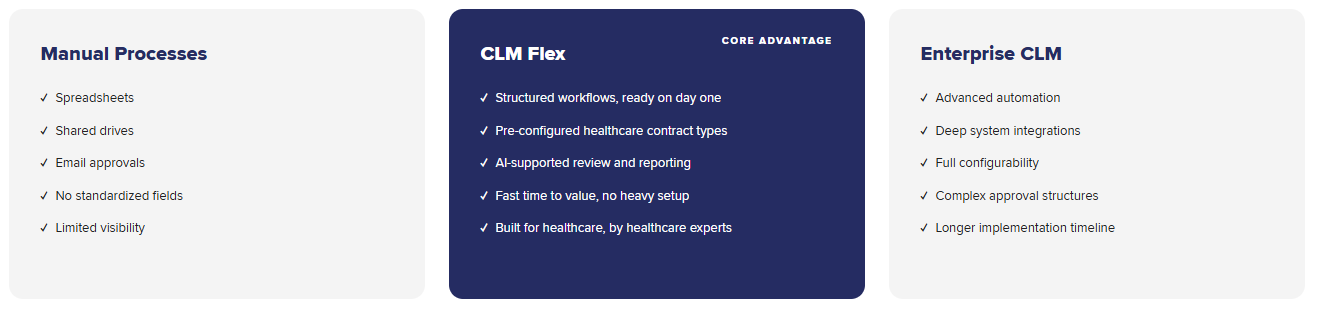
That gap is what CLM Flex was built to fill. But before we get there, it’s worth being honest about what staying in the spreadsheet actually costs.
What the data says about manual contract management.
These numbers reflect the experience of organizations at every size.
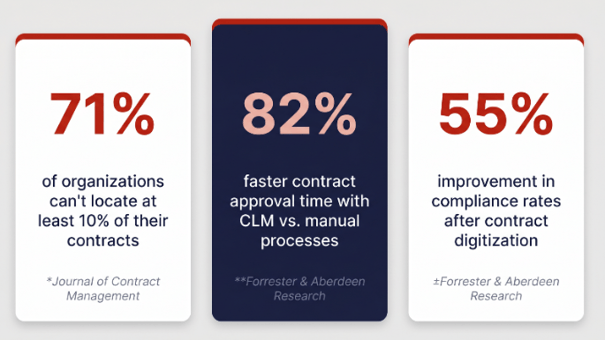
The 71% figure is worth sitting with. Not 71% of large health systems. 71% of organizations, period. If your contracts live across shared drives, email threads and individual desktops, the odds are that something is already missing. Not lost permanently. Just not findable when you need it.
The 82% faster approval time matters for lean teams especially. The average manual approval cycle takes 3.4 weeks. For teams where contract work is shared across other responsibilities, that time compounds. Approvals sitting in someone’s inbox rather than moving through a visible workflow create delays that are invisible until they’re not.
The compliance improvement is particularly relevant for healthcare organizations. Visibility into obligations, renewals and key dates doesn’t just make operations smoother. It changes what an audit or accreditation review looks like.
For organizations making their first move away from manual tracking, the gains aren’t incremental, they’re immediate.
How to know if your current approach isn’t scaling.
The decision to move to contract management software is usually prompted by a moment: the missed renewal, the contract nobody could find, the approval that sat in an inbox for three weeks. But those moments are visible symptoms of a system that has been under stress for longer than anyone realized.
Here are the signals worth paying attention to.
Is your current approach still scaling? Check what applies.
- You’re not sure where all your contracts live.
- Renewals are tracked by calendar alert or spreadsheet column, not by an automated system.
- Approvals happen over email with no central visibility into status or version.
- You can’t answer basic contract questions quickly: what’s active, what expires in 90 days, what auto-renews.
- New staff can’t pick up where the last person left off without a significant handover.
If three or more of these feel familiar, the question isn’t whether your organization needs a better system. The question is what that system should look like.
What right-sized contract management actually looks like.
The case for moving to structured contract management is clear. The more important question is what that structure should look like for an organization that doesn’t have a dedicated contract team, a large IT department or an enterprise implementation budget.
The answer isn’t the same as what a 500-bed health system needs. It’s something pre-configured, fast to deploy and designed around the way smaller teams work. Not a system that requires months of setup before it does anything useful.
For healthcare organizations specifically, that means:
- Contract types and data fields that reflect healthcare agreements, not generic commercial contracts that have to be adapted
- Approval workflows built for lean teams, not complex multi-tier structures designed for organizations with dedicated approval committees
- Renewal and obligation alerts that run automatically, not calendar reminders that depend on someone remembering to set them
- Reporting that gives a clear view of the portfolio without requiring a dedicated analyst to produce it
- Implementation that gets teams up and running quickly, not a six-month project requiring significant IT involvement
That’s the design brief behind CLM Flex. It’s not enterprise CLM scaled down; it’s healthcare contract management built from the ground up for organizations that need it to just work.
The organizations CLM Flex is built for.
CLM Flex is designed for community hospitals and smaller health systems, growing provider groups and specialty networks, FQHCs and community health centers, and teams managing contracts alongside other responsibilities without dedicated contract management resources.
What these organizations share is not a size. It’s a moment. The moment when the spreadsheet stops being enough. When the missed renewal or the lost contract makes clear that the current system has a ceiling.
That moment doesn’t require an enterprise solution. It requires the right one.
CLM Flex fits where you are today: no overbuying, no workarounds, no features you’ll never use.
Ready to see what contract management looks like when it’s built for your organization?
Explore CLM Flex or reach out to our team at sales@ntracts.com.