What carries forward depends on the deal, and the first 30 days decide how much you can defend.
TLDR
- Whether you inherit a physician group's compensation arrangements depends on how the deal is structured. In an equity deal or merger, they generally come with the entity. In an asset deal, you generally choose.
- Physician compensation compliance doesn't wait for integration. Stark is strict liability, and not knowing an arrangement exists is not a defense.
- Check every inherited arrangement for three Stark red flags: no signed writing, payments past the end date and no fair market value support.
- An ownership map turns an inherited pile of agreements into something you can manage: who owns each one, when it renews, what duties it covers and how those duties are documented.
- Spreadsheets work until the first audit. Physician compensation software that keeps contracts, FMV files and evidence together works longer.
The deal closes on a Friday. By Monday, someone in physician services is fielding a question about a medical director stipend nobody on the team has ever seen. The contract might be in a shared drive. The FMV opinion might be in someone's inbox. The person who negotiated the terms may already be gone.
That's what physician contract management looks like right after an acquisition. The announcement covers strategy and synergies. The arrangements the seller's physicians signed are the part that lands on your desk.
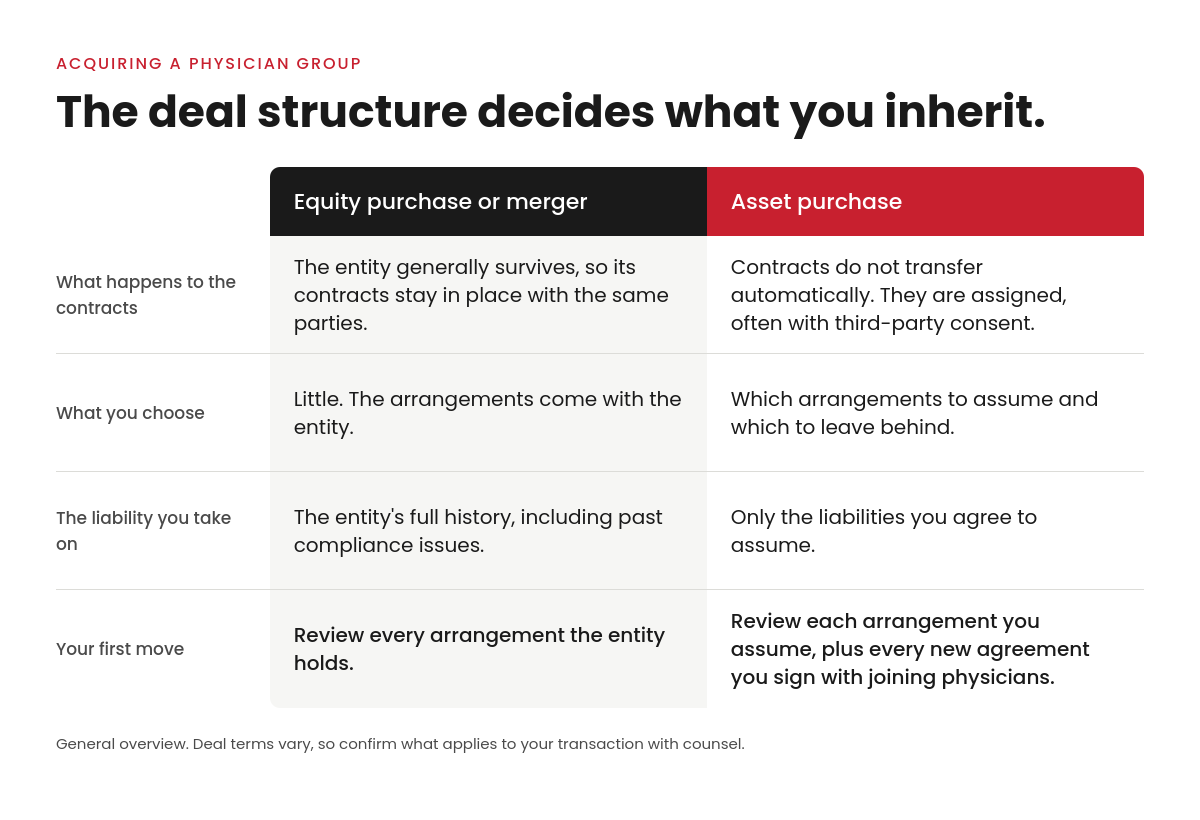
The deal structure decides what you inherit.
Before anything else, find out how the deal was built. It determines how many arrangements you need to find.
In an asset deal, the buyer selects specific assets and may assume certain liabilities, and contracts such as leases and payer agreements don't transfer automatically. They must be assigned, often with third-party consent. In a merger or stock acquisition, the entity being acquired frequently survives the transaction, so the parties to its contracts don't change. That also means the buyer inherits all liabilities, including past compliance issues.
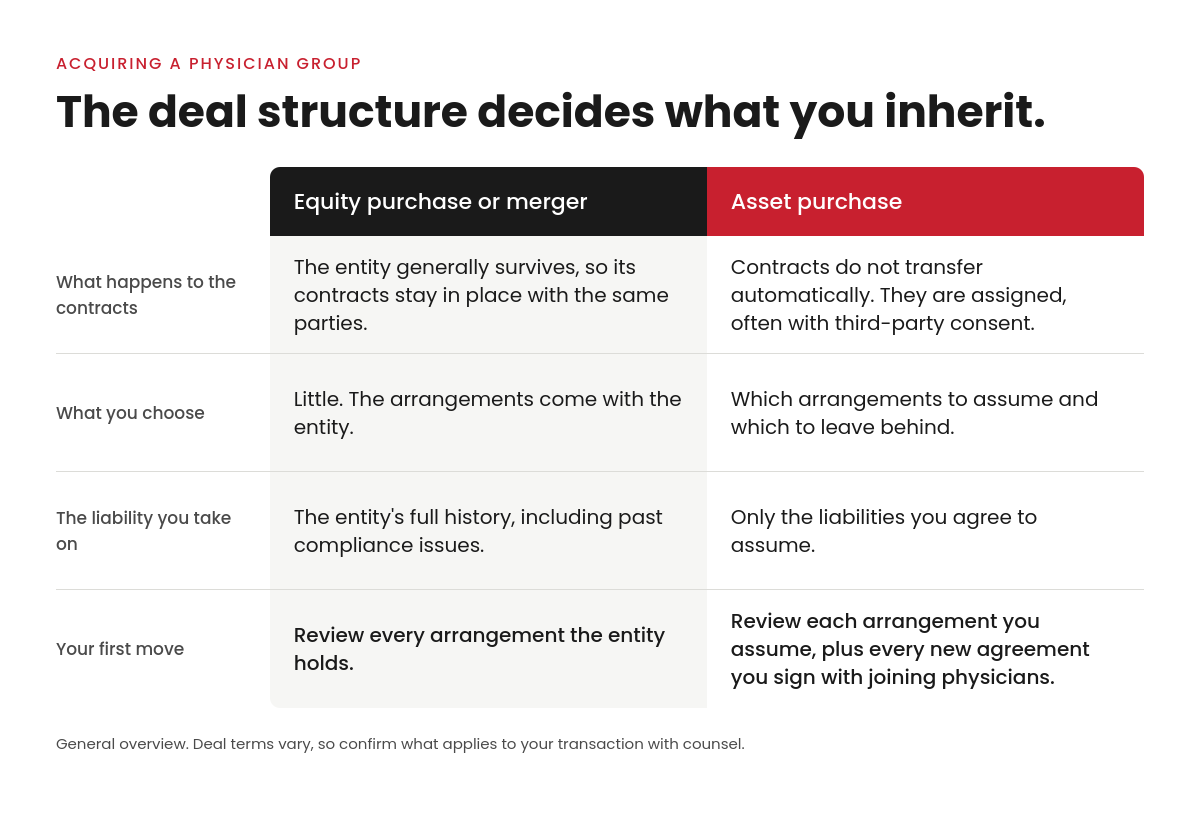
Two caveats. Asset deals look cleaner than they are, because every physician compensation arrangement set up after closing has to meet fair market value and can't be tied to referrals, including the new physician employment agreements you sign with the physicians who join you. And a contract can define a change in ownership as a transfer, so consent may be required. Read the terms before assuming a contract carries over unchanged.
Your attorneys will have worked through structure before closing. The practical point is to know which situation you're in, because it tells you how big the review will be.
Physician compensation compliance doesn't wait for integration.
Stark is a strict liability statute. There's no good-faith compliance: either the arrangement satisfies an exception or it doesn't.* An inherited arrangement carries the same obligations as one your own team signed, from the day you take it on, whether or not anyone has read it.
That makes the first weeks after a deal a triage exercise. You can't review everything at once, so start where problems tend to hide.
The first-30-days checklist: three flags to check first.
Physician contract compliance starts with three Stark red flags. Check each one on every inherited arrangement.
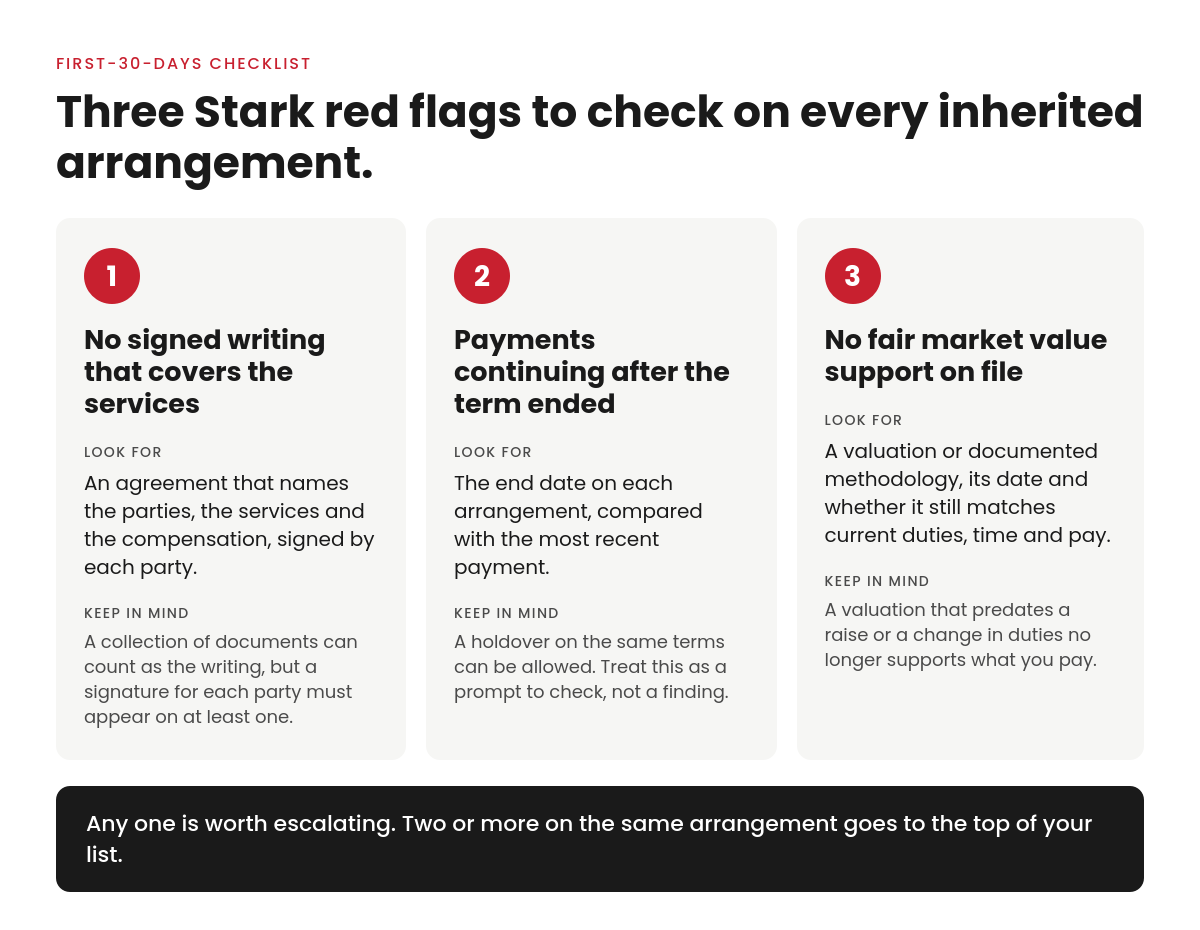
1. No signed writing that covers the services.
Most Stark compensation exceptions require the arrangement to be in writing. A collection of documents can satisfy that requirement, but a signature for each party must appear on at least one contemporaneous writing.** Look for an agreement that names the parties, the services and the compensation, with signatures. Limited grace periods exist for obtaining missing signatures, so raise any gap with counsel quickly.
2. Payments continuing after the term ended.
Pull the end date on each arrangement and compare it to the most recent payment. Holdovers can continue indefinitely if they run on the same terms and conditions as the original arrangement and maintain certain safeguards.*** So this flag is a prompt to check, not a finding. What matters is whether anyone is tracking the renewal, or whether payments have simply kept running, and whether the rate or terms have changed along the way.
3. No fair market value support on file.
Nearly every exception to the Stark Law requires that compensation paid to a physician be consistent with fair market value. Look for a valuation or documented methodology, check its date and confirm it still matches current duties, time commitment and pay. A valuation that predates a raise or a change in duties no longer supports what you're paying.
Any one of these is worth escalating. Two or more on the same arrangement moves it to the top of your list.
If you already use a new physician onboarding checklist, add these three checks to it for acquired physicians. A solid physician onboarding process is the natural place to catch a gap, because you're already pulling each physician's agreements together.
While you're in the files, also look for:
- Duties on paper that don't match the work being done
- Several arrangements for the same physician reviewed separately instead of together
- Payments approved by someone who has since left
Build an ownership map.
Flags tell you where to look. An ownership map tells you who's responsible for fixing what you find. For each inherited arrangement, record four things:
- Who owns it now. A named person, not a department. Include who owns the relationship with the physician, which is often a different person than the one who owns the contract.
- When it ends or renews. Include auto-renewal terms and the notice window.
- What duties the physician agreed to perform. Pulled from the agreement, in plain language.
- How those duties are documented. Time logs, meeting records, deliverables or nothing.
Add the arrangement's name at the start of each row and the flags you found at the end, so every row connects back to the checklist above.
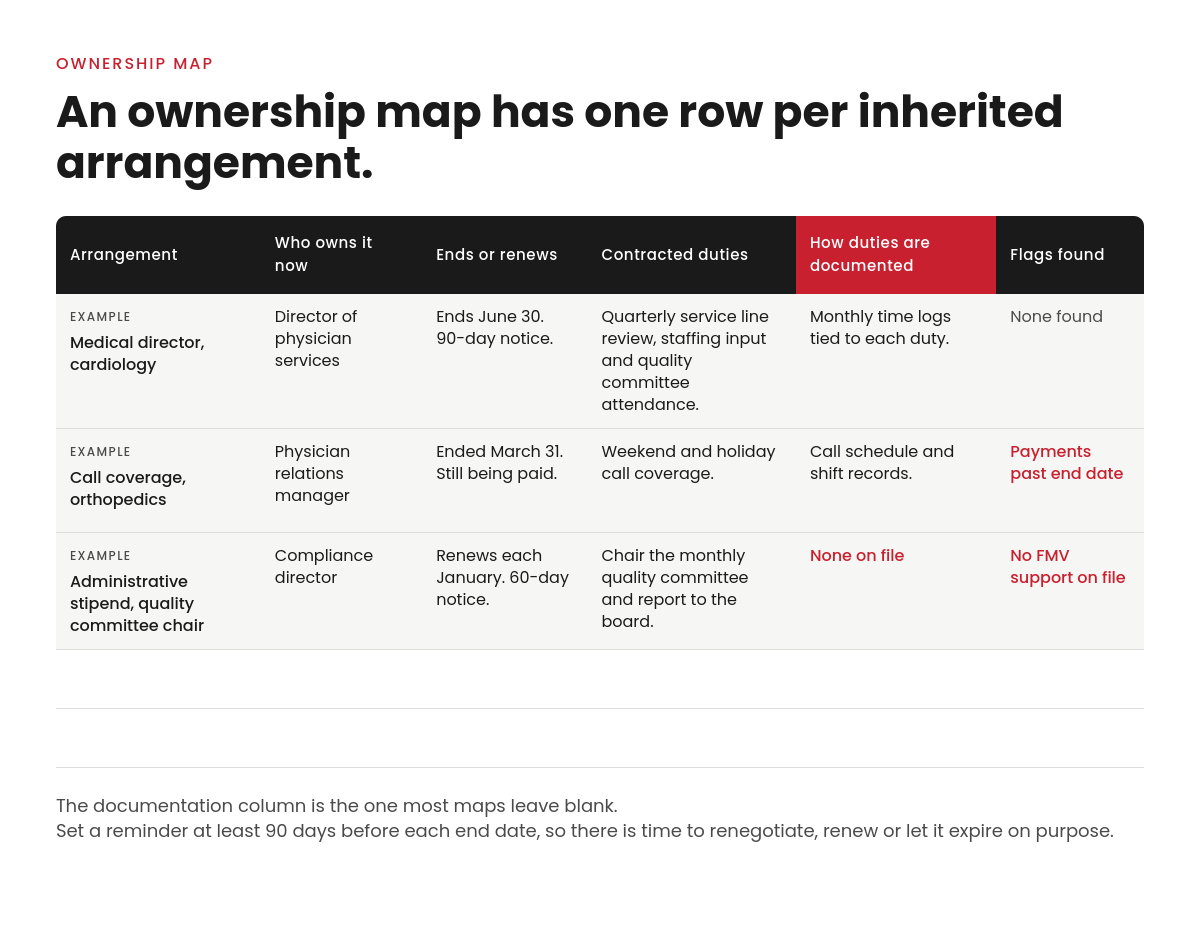
The renewal date is the one that slips. An arrangement that renews automatically with nobody watching keeps paying on terms no one on your team approved. Set a reminder at least 90 days before each end date, so there's time to renegotiate, renew or let it expire on purpose.
The documentation column is the one most maps leave blank. If the answer to "how are the duties documented" is "we aren't," that arrangement has a gap no matter how clean the contract looks.
How hospitals manage physician compensation with software at scale.
With a handful of arrangements, a spreadsheet works. With dozens spread across contracts, valuation files and email, it stops working the first time someone asks for the full picture. That's where provider compensation management tends to break down: the data exists, but it lives in several places.
Getting to the full picture is usually the slow part. AI Data Abstraction pulls key terms, such as end dates and renewal terms, straight from the agreement, so building your ownership map starts with data instead of a blank spreadsheet.
Physician compensation management software closes the rest of the gap. Ntracts keeps each arrangement connected to its contract, its FMV documentation and its key dates in one place, alongside physician relationship management, so the person who owns the relationship sees the same record. Automated workflows manage key dates, so a renewal doesn't pass unnoticed. Stark compliance logic is built into the medical director contract type, so a directorship isn't treated like any other agreement. And with physician time tracking, documentation of the services is captured as the work happens and linked to the duties in the agreement.
Common questions.
What software helps hospitals track physician employment agreements?
Look for physician contract management software that stores each agreement as structured data, not only as a file: parties, services, end and renewal dates and compensation terms. It should connect each agreement to its fair market value support and flag upcoming renewals. It should also tie the arrangement to evidence that the services were performed.
How do hospitals manage physician compensation with software?
They bring the contract, the compensation terms, the FMV documentation and the supporting data into one system, so compliance and finance work from the same record. Physician compensation compliance software adds checks on top: missing documentation, expired terms and arrangements without support get flagged instead of waiting for someone to look.
See how Ntracts Physician handles inherited arrangements: Request a demo
*42 U.S.C. 1395nn (Stark Law)
**42 CFR 411.354 and 411.357 (writing and signature requirements for compensation arrangements)
***Bipartisan Budget Act of 2018 and CMS Stark Law final rule, effective January 19, 2021

![[Webinar On-Demand] Primer on Health Care Transactions & Compliance Considerations: In-House and Outside Counsel Conversations](https://www.ntracts.com/hs-fs/hubfs/Imported_Blog_Media/Register-Now-LinkedIn_Healthcare-Transactions_Oct2024-01.jpg?width=352&name=Register-Now-LinkedIn_Healthcare-Transactions_Oct2024-01.jpg)