
The Complete Guide To Healthcare Contract Management.
Table of contents
Section 1: Why healthcare contract management is a strategic priority
Section 2: What is healthcare contract management?
Section 3: Why healthcare contract management is uniquely complex
Section 4: Who owns contract management in healthcare?
Section 5: Key risks & consequences of poor healthcare contract management
Section 6: How healthcare contract management improves organizational performance
Section 7: How technology supports healthcare contract management.
Section 8: How healthcare organizations mature over time
Section 9: When is it time to upgrade or replace your contract management approach?
Section 10: Conclusion-Establishing contract management as strategic infrastructure.
This guide includes healthcare-specific and industry terminology; definitions and explanations can be found in our glossary.
SECTION 1:
Why healthcare contract management is a strategic priority.
Healthcare organizations operate in one of the most regulated and financially pressured industries in the country. Every payer relationship, vendor partnership, physician arrangement, technology investment and compliance obligation is governed by a contract.
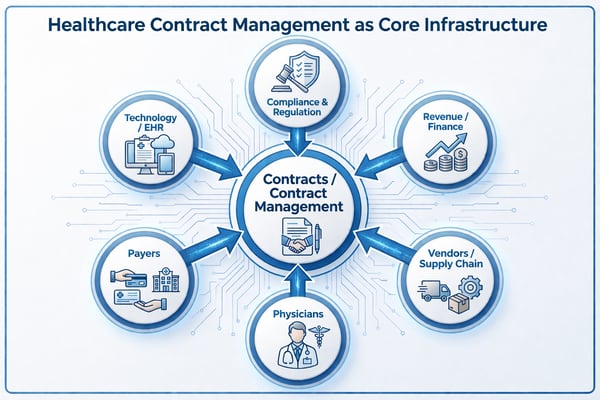
Yet for years, contract management in many healthcare organizations has been treated as an administrative function- something managed in shared drives, email chains or siloed departments.
That model no longer works.
Today, healthcare contract management is a strategic infrastructure. It directly impacts compliance, revenue, operational performance and long-term organizational stability.
Here’s why.
Rising regulatory scrutiny in healthcare.
Healthcare operates under intense federal and state oversight, with regulations from CMS, the Office of Inspector General (OIG), Stark Law, the Anti-Kickback Statute, HIPAA, and accreditation bodies creating a highly controlled environment. Contracts are where these requirements become operational, requiring vendor agreements to include proper compliance language, physician contracts to meet fair market value (FMV) standards, business associate agreements to satisfy HIPAA requirements, and value-based arrangements to align with evolving CMS guidance. When contracts are decentralized or poorly tracked, organizations face increased audit risk, inconsistent language and potential regulatory exposure. If leadership cannot quickly answer questions such as these, then the organization is vulnerable:
-
Which agreements contain value-based incentive language?
-
Which contracts reference outdated compliance standards?
-
Which physician arrangements require annual review?
Regulatory scrutiny continues to increase, and defensibility requires centralized visibility into contractual obligations. Contract management is no longer about document storage; it’s about compliance assurance.
Financial pressure on hospitals and health systems.
Healthcare margins remain tight across the country, with rising labor costs, supply chain disruptions, reimbursement pressure, and shifting payer mixes leaving many hospitals operating on thin or negative margins. In this environment, contract mismanagement translates directly into financial loss, often through auto-renewals at unfavorable pricing, missed renegotiation opportunities, unmonitored rate escalators, underperforming payer reimbursement terms, and duplicate vendor agreements. When contracts are scattered across departments, this financial leakage frequently goes unnoticed.
Effective healthcare contract management brings visibility into upcoming renewals, high-value vendor agreements, contracts tied to performance incentives, and reimbursement structures across payers. Contracts are financial assets, and managing them strategically helps protect margins, support sourcing initiatives, and strengthen negotiation leverage.
Increasing contract volume and complexity.
Modern healthcare organizations manage thousands of contracts, including:- Vendor and supply agreements
- Physician employment and medical director contracts
- Payer agreements
- IT and EHR contracts
- Business associate agreements
- Clinical research agreements
- Real estate leases and affiliations
Each contract includes unique renewal terms, pricing structures, regulatory clauses and performance obligations.
As organizations grow, particularly through mergers and acquisitions, contract volume multiplies. Legacy agreements are often inherited without centralized documentation or standardized language. When contracts are managed in silos, organizations experience:
- Delayed approvals
- Version control issues
- Conflicting terms
- Limited visibility into risk exposure
Manual processes cannot scale with this complexity.
From administrative function to strategic infrastructure.
Every major healthcare initiative begins and ends with a contract. When a health system expands service lines, launches a telehealth program, implements new technology, partners with physician groups, or enters value-based reimbursement arrangements; contracts sit at the center of execution. They define financial terms, allocate risk, establish compliance obligations and formalize the relationships that drive patient care delivery.Yet for many organizations, contract management has historically been treated as an administrative necessity rather than a strategic capability. Agreements were drafted, signed, scanned and stored. Oversight lived in silos. Reporting was reactive. Renewals were tracked manually. Risk was addressed only after problems surfaced- an approach that is no longer sustainable in today’s healthcare environment.
As healthcare organizations grow larger, more integrated and more data-driven, unmanaged contracts quietly erode margins, increase audit exposure and slow strategic execution. Organizations that elevate contract management into a strategic function gain stronger compliance visibility, improved financial performance, faster negotiations, reduced operational risk and clearer executive insight.
Contracts are not paperwork. They are enterprise infrastructure. As complexity increases, healthcare organizations must move from reactive storage to proactive contract lifecycle management.
The rest of this guide will explore how.
SECTION 2:
What is healthcare contract management?
Healthcare organizations rely on contracts to govern nearly every operational relationship, from payer reimbursement and physician employment to vendor services and research partnerships. Because these agreements define financial terms, regulatory obligations and operational expectations, managing them effectively is essential to both organizational stability and patient care delivery.
Healthcare contract management refers to the structured process used to oversee these agreements throughout their entire lifecycle. Rather than treating contracts as static documents stored after signature, modern healthcare organizations actively manage contracts from creation through renewal or termination. This lifecycle approach ensures agreements remain visible, enforceable, and aligned with organizational goals over time.
Effective contract management helps healthcare organizations reduce risk, maintain regulatory compliance, improve financial oversight and ensure operational alignment across departments. As contract volume and complexity continue to grow, organizations increasingly view contract management not as an administrative task, but as a critical operational capability.
Common types of healthcare contracts.
Key healthcare contract categories
Payer agreements
Payer agreements are among the most financially significant contracts in healthcare. These agreements define the relationship between healthcare providers and insurance companies, including reimbursement rates, billing procedures, coverage rules and participation in value-based care programs. Because payer contracts directly influence revenue cycle performance, they require careful oversight and ongoing monitoring.
Provider agreements
Provider agreements govern relationships between healthcare organizations and clinicians or affiliated care providers. Hospitals and health systems often maintain agreements with physician groups, specialists and partner care organizations that deliver services within their network. These contracts outline responsibilities related to care delivery, referral relationships and financial arrangements.
Vendor and supply contracts
Vendor and supply contracts support the operational infrastructure required to deliver healthcare services. Organizations rely on vendors for medical equipment, pharmaceuticals, IT platforms, facility services and administrative support. These agreements establish pricing, service-level expectations, delivery schedules and performance standards.
In many cases, these relationships also involve access to protected health information, requiring Business Associate Agreements (BAAs) to ensure compliance with HIPAA. BAAs define how vendors handle, store and safeguard patient data, as well as their responsibilities in the event of a breach. Without properly structured BAAs, organizations face significant regulatory and financial risk, making them a critical component of vendor contract management.
Clinical research agreements
Clinical research agreements are common within academic medical centers and research-focused healthcare organizations. These contracts define relationships between healthcare providers, pharmaceutical companies and research sponsors involved in clinical trials. They establish regulatory responsibilities and study protocols, data reporting requirements and financial arrangements related to research participation.
Employment and physician agreements
Employment and physician agreements define the terms of employment between healthcare organizations and the clinicians and staff who deliver care. These agreements typically include compensation structures, productivity expectations, compliance obligations and professional responsibilities.
Defining healthcare contract management.
Healthcare contract management is the systematic oversight of agreements throughout their full lifecycle, from initial drafting and negotiation to execution, monitoring and renewal. The goal is to ensure contractual obligations are clearly defined, properly approved and actively managed once the agreement is in place.
Historically, many healthcare organizations treated contract management primarily as document storage. Agreements were signed, scanned and archived in shared drives or filing systems, often without structured oversight. Contracts might only be revisited when a dispute occurred or when someone noticed a renewal deadline approaching.
Today, that approach is no longer sufficient. Healthcare contracts contain critical information that directly affects financial performance, regulatory compliance and operational coordination. Payment rates, service expectations, reporting requirements and legal protections are all embedded within these agreements. If organizations cannot easily access or monitor those terms, they risk missed revenue opportunities, compliance exposure and operational inefficiencies.
Modern healthcare contract management therefore covers the entire contract lifecycle, including creation, review, negotiation, approval, execution, ongoing monitoring and eventual renewal or termination. This lifecycle approach allows organizations to maintain visibility into obligations, ensure accountability and manage agreements proactively rather than reactively.
Importantly, healthcare contract management applies across the broader healthcare ecosystem. Hospitals, health systems, physician groups, research institutions and healthcare vendors all rely on contracts to formalize their relationships. Whether the agreement governs reimbursement, clinical collaboration, vendor services or employment terms, effective contract management ensures these relationships are structured, compliant and strategically aligned.
Understanding the healthcare contract lifecycle.
Every healthcare contract progresses through a defined lifecycle that governs how agreements are created, approved, executed and managed over time. While the exact processes may vary by organization, most contracts follow a similar sequence of stages.
Creation
The lifecycle begins with contract creation, where a new agreement is drafted. During this stage, organizations typically use standardized templates to ensure consistency in legal language, regulatory protections and organizational policies. Key terms such as scope of services, pricing, responsibilities and timelines are established at this stage.
Review
Next, the contract moves into the review phase. Internal stakeholders, including legal, compliance, finance and operational teams, evaluate the agreement to ensure it aligns with regulatory requirements, financial expectations and operational capabilities.
Negotiation
Following review, the contract enters negotiation, where the involved parties discuss proposed changes and refine the terms of the agreement. Negotiations often address payment structures, service expectations, liability provisions and compliance obligations.
Approval
Once both parties agree on the terms, the contract moves to internal approval. At this stage, authorized leaders or designated approvers review the agreement and formally authorize it according to organizational governance policies.
Execution
After approval, the contract proceeds to execution, meaning the agreement is signed by the relevant parties and becomes legally binding.
Monitoring
However, effective contract management does not end with signature. Once executed, contracts enter the active management phase, where organizations monitor obligations, track performance and maintain visibility into key milestones such as reporting requirements or service deliverables.
Renewal
Finally, every contract reaches a renewal, amendment or termination stage. Organizations must determine whether the agreement should be extended, renegotiated, modified or concluded based on performance, financial outcomes and strategic priorities.
SECTION 3:
Why healthcare contract management is uniquely complex.
Contract management exists in every industry, but healthcare organizations face a level of complexity that is rarely seen in other sectors. Hospitals, health systems and healthcare networks operate within a highly regulated environment while managing thousands of agreements that directly affect patient care, reimbursement and regulatory compliance.
In many industries, contracts primarily govern pricing, service delivery and liability. In healthcare, contracts often carry additional layers of regulatory oversight, reimbursement rules and compliance obligations. Agreements may need to align with federal and state regulations, payer policies, internal governance requirements and clinical operational standards- all at the same time.
Because of these factors, healthcare contract management requires more structured oversight, cross-department coordination and visibility than contract management in most other industries.
Regulatory and financial complexity in healthcare contracts.
One of the primary reasons healthcare contract management is more complex than in other industries is the extensive regulatory framework that governs healthcare relationships. Federal laws such as the Stark Law, the Anti-Kickback Statute and numerous CMS regulations influence how healthcare organizations structure financial relationships and contractual arrangements.
For example, physician compensation agreements must be carefully structured to avoid violations of self-referral regulations. Vendor agreements may require compliance with fraud and abuse laws. Research partnerships must align with regulatory requirements related to clinical trials and patient protections. Each of these factors introduces additional legal review and compliance oversight into the contracting process.
Healthcare contracts also play a direct role in reimbursement. Payment rates, billing rules, value-based care arrangements and performance incentives are frequently embedded within payer agreements. Because reimbursement terms directly influence revenue cycle performance, inaccuracies or poor visibility within these contracts can lead to significant financial impact.
Audit exposure adds another layer of complexity. Healthcare organizations may be subject to audits from government agencies, accreditation bodies and payers. During these reviews, organizations must often demonstrate that contractual relationships comply with regulatory requirements and that obligations are being properly fulfilled. Without clear documentation and contract oversight, preparing for these audits can become difficult and time-consuming.
Healthcare agreements also frequently involve multiple stakeholders. A single contract may require coordination between legal teams, compliance officers, finance departments, clinical leadership and operational staff. This multi-party structure makes consistent contract management processes even more important.
Structural differences between hospitals, health systems and IDNs.
The structure of a healthcare organization significantly influences how contract management is handled. While smaller hospitals may manage contracts within a single administrative structure, larger organizations often operate across multiple facilities, service lines and legal entities.
Independent hospitals typically manage contracts through a small number of departments such as legal, compliance or supply chain. While the contract volume may be lower, these organizations often rely on manual processes and decentralized document storage, which can make visibility and oversight more difficult.
Health systems introduce additional complexity because they oversee multiple hospitals, clinics and outpatient facilities. Contracts may be created at the local facility level while governance and policy decisions are made centrally. Without standardized processes and centralized visibility, contract data can become fragmented across departments or locations.
Integrated Delivery Networks (IDNs) represent an even broader operational structure. These networks often include hospitals, physician groups, outpatient centers and sometimes health plans within the same organization. Because of this structure, IDNs manage a large volume of contracts that span multiple operational areas, from payer agreements to physician partnerships and vendor relationships.
Academic medical centers add another layer of complexity. These organizations frequently manage clinical research agreements, academic partnerships and faculty employment contracts in addition to traditional hospital and vendor agreements. The combination of healthcare delivery, research activity and academic collaboration increases both contract volume and regulatory oversight requirements.
As healthcare organizations grow in size and complexity, the need for centralized governance and standardized contract management processes becomes increasingly important.
SECTION 4:
Who owns contract management in healthcare?
Contract management in healthcare does not sit neatly within a single department. Unlike other industries where ownership may clearly fall under legal or procurement, healthcare organizations operate within a matrix of stakeholders who each play a distinct role across the contract lifecycle. Legal, compliance, supply chain and finance all contribute to how contracts are created, executed, monitored and enforced. This shared ownership reflects the complexity of healthcare itself, but it also introduces operational challenges when roles are not clearly defined.
Understanding who owns contract management is less about identifying a single department and more about clarifying accountability across functions. High-performing organizations recognize that contract management is inherently cross-functional, but they also establish governance models that prevent fragmentation and ensure alignment.
Shared ownership
Legal vs Compliance vs Supply Chain vs Finance.
Each department involved in contract management brings a different lens, shaped by its core responsibilities and risk exposure.
Legal
Legal teams are typically responsible for drafting, reviewing and negotiating agreements. They ensure that contract language is enforceable, that liability is appropriately allocated and that terms align with regulatory requirements. In healthcare, this includes careful attention to laws such as Stark and Anti-Kickback, as well as structuring agreements in ways that withstand external scrutiny. Legal’s role is critical at the front end of the lifecycle, but in many organizations, their involvement decreases once the contract is executed.
Compliance
Compliance teams operate with a different mandate. Their focus is not on how contracts are written, but on whether the organization is adhering to the terms and regulatory obligations embedded within them. This includes monitoring arrangements for fair market value, ensuring required documentation is maintained and preparing for internal or external audits. Compliance often relies on contract data to validate that physician agreements, vendor relationships and financial arrangements remain within regulatory boundaries. Without visibility into active contracts, compliance functions become reactive rather than proactive.
Supply Chain
Supply chain teams are most closely tied to vendor-related agreements. They are responsible for ensuring that pricing terms, service levels and deliverables negotiated in contracts are actually realized in practice. This includes managing vendor performance, enforcing agreed-upon terms and identifying opportunities for cost savings. In many healthcare organizations, supply chain also plays a role in initiating contracts, particularly those tied to purchased services, equipment or group purchasing organization (GPO) relationships. Their perspective is operational and cost-focused, emphasizing execution over structure.
Finance
Finance brings yet another critical dimension. Contract terms often dictate reimbursement rates, payment structures, escalation clauses and financial risk. Finance teams rely on contracts to validate revenue expectations, manage budgets and forecast financial performance. In payer-provider agreements, for example, finance must understand the nuances of reimbursement models, including value-based arrangements and risk-sharing provisions. Without clear access to contract data, financial planning becomes less accurate and more vulnerable to leakage.
Shared governance challenges.
The question of who owns contract management in healthcare is not answered by choosing a single department. Instead, ownership is inherently shared, with each function responsible for a different stage of the lifecycle. Legal focuses on drafting and negotiation, compliance on oversight and audit readiness, supply chain on vendor performance, and finance on financial impact. The challenge is not defining ownership, but ensuring these roles operate in coordination rather than isolation.
While this cross-functional model is necessary, it often leads to fragmented processes when governance is unclear. Contracts are frequently stored across multiple systems, making it difficult to maintain a single source of truth or gain full visibility into obligations. Competing priorities across departments, such as legal focusing on risk, supply chain on speed, finance on cost, and compliance on regulation, can create delays and inconsistent standards without proper alignment. At the same time, unclear accountability often leaves gaps in post-execution oversight, leading to missed renewals, unenforced terms, and increased risk.
Fragmented reporting further limits visibility, making it difficult for leadership to understand contract exposure, risk, and financial impact. Organizations that address these challenges adopt a shared governance model supported by standardized processes, clear ownership, and centralized systems, allowing each function to contribute within a unified, more strategic framework.
Snapshot
Gaps in ownership and visibility
As contract activity spans multiple departments, gaps in accountability and visibility become more common. Without clear alignment, important details can be overlooked and responsibilities can become inconsistent, making it harder to maintain control and ensure contracts are managed effectively across the organization.
*Juro Contract Management Statistics Report
**World Commerce & Contracting (IACCM) Contracting Principles & Performance Report
of organizations say it’s unclear who is responsible for contract-related tasks*
of organizations lack full visibility into their contracts due to fragmented ownership and siloed processes**
SECTION 5:
Key risks & consequences of poor healthcare contract management.
As healthcare organizations continue to expand partnerships, adopt new reimbursement models and operate under intense regulatory oversight, the margin for error in contract management becomes increasingly narrow. When contract management lacks structure, visibility and accountability, the consequences extend far beyond administrative inefficiencies. They introduce measurable compliance exposure, financial loss and legal vulnerability.
This is not simply an operational issue, it’s an enterprise-wide vulnerability. Poor contract management is not simply an operational inconvenience, it’s a systemic risk that can impact every corner of a healthcare organization.
The compliance risks of poor healthcare contract management.
-
Lack of centralized visibility into contracts makes it difficult to ensure regulatory requirements are consistently met
-
Inability to produce compliant agreements or supporting documentation during audits
-
Decentralized storage leading to reactive, manual audit processes and slower response times
-
Documentation gaps including missing amendments, unsigned agreements, and conflicting contract versions
-
Limited ability to track and monitor compliance obligations across active agreements
Hidden financial risks in healthcare contracts.
-
Missed renewals and auto-renewals leading to unfavorable terms, pricing disadvantages, or service disruptions
-
Untracked contractual obligations such as pricing tiers, rebates, volume commitments, and performance incentives
-
Revenue leakage from discrepancies between expected and actual reimbursement, especially in managed care contracts
-
Limited visibility into contract terms and performance, preventing optimization of financial outcomes
-
Reliance on manual tracking tools like spreadsheets or shared drives, increasing missed deadlines and preventable losses
The legal consequences of inadequate contract oversight.
Poor contract management also increases the likelihood of legal disputes. When contract terms are unclear, outdated or inconsistently enforced, disagreements between parties become more likely.
Disputes often stem from ambiguous language or multiple versions of the same agreement. Without a centralized repository, it can be difficult to determine which version is authoritative, complicating resolution and increasing legal costs.
Failure to meet contractual obligations can result in breach of contract claims, whether related to service levels, payment terms or performance expectations. These issues can escalate quickly if not identified early.
Beyond direct legal exposure, disputes can damage relationships with physicians, vendors and payers. In a highly collaborative industry like healthcare, strained partnerships can have lasting operational and strategic consequences.
Why manual contract tracking fails in healthcare.
Manual contract tracking fails in healthcare because it lacks real-time visibility, consistency and scalability in a highly regulated, high-volume environment. It relies on individual ownership, making it easy to miss critical milestones like renewals, audits and compliance requirements, while also limiting the ability to generate meaningful insights due to unstructured data. As contract volume grows, these fragmented processes become increasingly reactive and error-prone, leaving organizations without a clear understanding of financial performance or compliance risk.
trend
A common reality across healthcare organizations.
This isn’t a rare issue- it’s happening across healthcare organizations every day. Small breakdowns in contract management quickly add up, creating ongoing disruption, financial loss and increased regulatory pressure. Without structure, teams are constantly reacting instead of operating with control.

SECTION 6:
How healthcare contract management improves organizational performance.
As healthcare organizations mature their approach to contract management, it becomes a direct driver of performance across operations, finance and strategy. A connected, visible contract lifecycle enables organizations to move faster, reduce risk and make more informed decisions. The impact is most clearly seen across three key areas:
THE IMPACT
Core Performance Benefits
1. Operational efficiency and reduced contract cycle time
Standardizing intake, drafting and approvals eliminates delays caused by manual processes and unclear ownership. Contracts move faster from request to execution, reducing cycle time and accelerating initiatives like vendor onboarding, physician alignment and service line expansion.
2. Breaking down silos and improving collaboration
Centralized contract management creates a single source of truth across legal, compliance, finance and supply chain. This shared visibility reduces miscommunication, eliminates duplicated effort and ensures decisions are made with full context, strengthening coordination across departments.
3. Revenue protection and cost control
Improved visibility into contract terms ensures reimbursement, payment schedules and obligations are tracked and enforced, which reduces revenue leakage and improves accuracy. Stronger oversight of vendor agreements helps control costs and supports more effective renegotiation, while enabling organizations to manage complex value-based care arrangements.
SECTION 7:
How technology supports healthcare contract management.
Technology is what enables healthcare organizations to operationalize the contract lifecycle, turning it from a series of disconnected steps into a controlled, scalable and data-driven function.
Not all contract management platforms are built for healthcare. Generic CLM tools can manage basic workflows, but they often fall short when applied to the unique demands of healthcare organizations.
Contract management technology and AI as a performance driver.
Modern contract management technology, enhanced by AI, transforms how healthcare organizations capture, manage, and act on contract data across the lifecycle. AI-driven extraction pulls key terms, obligations, and financial data directly from contracts and structures it within the system, eliminating manual data entry and improving accuracy.
Rather than relying on generative AI for drafting, organizations can use intelligent drafting tools to build contracts with pre-approved language and dynamic clauses, ensuring consistency, compliance, and greater control. During negotiation, advanced contract review capabilities streamline redlining by comparing versions, incorporating negotiated language, and simplifying the review process for legal teams.
Emerging capabilities like clause-level search further enhance visibility, allowing organizations to analyze contracts at scale- such as identifying agreements below specific dollar thresholds or locating specific terms across the entire repository. Together, these technologies provide deeper insight, reduce risk, and elevate contract management from a manual process to a high-impact, data-driven function.
Key differences include
Industry configuration
Compliance capabilities
Integration requirements
Core features healthcare organizations should expect:
-
Advanced search and visibility: Quickly locate contracts, clauses and key terms across large volumes of agreements.
-
Automated alerts and renewals: Proactively track deadlines to avoid missed renewals and unfavorable terms.
-
Compliance tracking and reporting: Monitor obligations, approvals and generate audit-ready reports.
-
System integrations: Connect contract data with ERP, EHR and GRC systems for broader operational alignment.
Build vs buy considerations.
Healthcare organizations often weigh building an internal solution against implementing a purpose-built platform. While building may offer more control, it comes with real challenges. Limited IT resources and competing priorities can delay development and ongoing support. Regulatory complexity makes it difficult to design a system that fully meets compliance and audit requirements. And over time, maintenance, upgrades and scalability can drive costs higher than expected.
In most cases, purpose-built healthcare contract management solutions deliver faster results with less risk. The decision ultimately comes down to whether the organization wants to focus on building software or improving contract performance.
SECTION 8:
How healthcare organizations mature over time.
Healthcare contract management maturity does not happen all at once. It evolves in stages as organizations move from reactive, fragmented processes toward proactive, enterprise-wide control. Each stage reflects not just improvements in tools, but a shift in how contracts are understood, from static documents to strategic assets that influence compliance, financial outcomes and operational performance.
The Evolution of Contract Management Maturity
Manual and decentralized
Contracts are scattered across emails, shared drives, and departments with no clear ownership. Limited visibility and inconsistent processes create high risk and make audits and reporting difficult.
Basic tracking systems
Organizations begin tracking key dates and contracts using spreadsheets or simple tools. While this improves awareness, processes remain manual, error-prone, and difficult to scale.
Centralized and structured
Contracts are stored in a centralized system with standardized workflows and defined ownership. This improves visibility, strengthens compliance, and enables more efficient management across teams.
Enterprise-level visibility and strategy
A fully integrated, purpose-built platform manages contracts across the entire lifecycle. Organizations gain real-time insights, stronger audit readiness, and the ability to use contracts as a strategic asset.
the numbers
What mature CLM actually delivers.
Organizations that implement mature contract lifecycle management processes gain far greater control over their financial and operational outcomes. By replacing manual, fragmented workflows with automation and centralized visibility, they significantly reduce payment errors and ensure contract terms are consistently enforced. Over time, this level of discipline not only improves accuracy but also drives meaningful cost savings and stronger overall performance.
*World Commerce & Contracting (formerly IACCM)
**Bain & Company / World Commerce & Contracting
Contract Cycle Time
Average time from draft to signature across all contract types.
Revenue by Quarter
Quarterly revenue growth driven by faster contract execution.
Contract Types
Breakdown of contracts managed across all agreement categories.
Manual vs Automated
How automation has replaced manual review steps in our workflow.
SECTION 9:
When is it time to upgrade or replace your contract management approach?
As healthcare organizations grow, contract management must keep pace. What once worked, manual tracking, shared drives or basic systems, can quickly become a source of risk and inefficiency as contract volume and complexity increase. Recognizing when to evolve your approach is key to maintaining control and supporting strategic initiatives.
Signs your healthcare organization has outgrown manual contract management.
-
Contracts are difficult to locate or scattered across multiple systems
-
Renewals and key deadlines are missed or inconsistently tracked
-
Audit preparation is reactive, manual and time-consuming
-
Limited visibility into contract status, obligations and financial exposure
-
Inability to quickly answer basic questions about contracts
-
Increasing compliance risk, revenue leakage and operational inefficiencies
When is it time to replace your contract management system?
It is time to consider a new system when your current solution no longer provides visibility, adoption or meaningful reporting. If teams rely on spreadsheets outside the system, struggle to use it consistently, or need manual effort to generate insights, the system is limiting performance. Another clear sign is when the platform cannot support evolving needs such as value-based care, increasing regulatory requirements, and enterprise-wide visibility, making it a barrier instead of a strategic tool.
How to evaluate healthcare contract management software.
A strong evaluation focuses on how well a solution supports the full contract lifecycle, not just individual features. The system should provide seamless workflows from intake through renewal, with clear visibility into obligations and performance.
Ease of use is critical for adoption across departments, and reporting should provide real-time insight into contract risk and financial impact. Integration with systems like ERP, EHR and GRC platforms is also essential to ensure contract data supports broader operations.
Just as important is healthcare alignment. The platform should support compliance, audit readiness and complex financial arrangements without requiring heavy customization.
RESOURCE
2026 Healthcare CLM Buyer's Guide
For a deeper, structured approach, including detailed evaluation criteria, implementation guidance and real-world vendor questions, download our 2026 Healthcare CLM Buyer’s Guide. It’s designed specifically for healthcare organizations to help you define goals, compare solutions, and make a confident, informed decision.

Questions to ask vendors during a healthcare CLM demo.
Does this solution provide a true end-to-end contract lifecycle management system, or is it primarily a repository?
End-to-end CLM systems manage the full lifecycle of a contract- from intake and drafting through execution, obligation tracking, and renewal.
Repositories, by contrast, primarily store documents and may offer search capabilities but lack workflow automation, governance, and lifecycle visibility.
Can users initiate, draft, redline, approve, sign and manage contracts within a single platform?
A comprehensive platform should support all core contract activities in one place. If multiple tools are required for drafting, approvals, or signing, it can create inefficiencies, version control issues, and gaps in auditability.
How does the system support healthcare-specific compliance requirements (e.g., Stark Law, Anti-Kickback)?
Healthcare-focused systems typically include configurable fields, clause libraries, and workflows designed to capture compliance-related data and enforce required approvals. Generic systems may require customization to address these regulatory needs.
What workflows are available, and how easily can they be configured for different contract types?
Most CLM platforms offer workflow automation, but flexibility varies. More advanced systems allow users to configure workflows based on contract type, risk level, or department without heavy IT involvement.
How does the platform track post-execution obligations, such as reporting requirements or performance terms?
Mature systems track obligations as structured data, assigning ownership, deadlines, and alerts. Less advanced tools may rely on manual tracking or lack visibility into obligations after execution.
What level of visibility does the system provide into contract status, approvals and risk exposure?
Strong platforms provide real-time dashboards and status tracking across the lifecycle. Limited systems may only show document-level information without insight into progress, bottlenecks, or risk.
How robust are the reporting and analytics capabilities? Can reports be customized?
Reporting capabilities range from basic export functions to advanced analytics with customizable dashboards. The ability to tailor reports is important for tracking performance, compliance, and financial metrics.
Does the platform include embedded eSignature functionality, and is it included in pricing?
Some platforms include native eSignature, while others integrate with third-party tools. It’s important to understand whether this is built-in or requires additional licensing.
How does the system support audit readiness and documentation tracking?
Audit-ready systems maintain a complete, time-stamped record of contract activity, including versions, approvals, and changes. This creates a clear audit trail and simplifies regulatory reviews.
What integrations are available with ERP, EHR or GRC systems?
Integration capabilities vary widely. More advanced systems offer pre-built or configurable integrations to connect contract data with financial, clinical, and compliance systems.
Does the platform support single sign-on (SSO) and role-based security controls?
Enterprise-grade platforms typically support SSO and allow administrators to define user roles and permissions, ensuring appropriate access and data security.
What does implementation look like in terms of timeline, resources and support?
Implementation timelines can range from a few weeks to several months depending on complexity. Key factors include data migration, configuration, integrations, and internal resource availability.
How does the vendor support onboarding, training and ongoing optimization?
Vendors may offer a range of support models, from basic onboarding to ongoing training, customer success management, and system optimization services.
What AI or automation capabilities are included (e.g., contract review, clause recommendations)?
Some platforms include AI-driven features such as clause extraction, risk identification, and automated recommendations. The level of sophistication and accuracy can vary significantly.
How are tasks, notifications and collaboration managed within the system?
Modern CLM systems include task assignment, automated notifications, and collaboration tools to streamline communication and ensure accountability throughout the lifecycle.
What does pricing include, and what additional costs should be expected over time?
Pricing structures vary and may include base licensing, user fees, implementation costs, integrations, and add-ons. It’s important to understand both upfront and ongoing costs to assess total cost of ownership.
SECTION 10:
Conclusion: Establishing Contract Management as Strategic Infrastructure.
Healthcare contract management is no longer optional infrastructure, it is foundational to how organizations manage risk, protect revenue, and operate at scale. When contracts are visible, controlled, and actively managed, organizations strengthen compliance, improve financial performance, and create alignment across departments.
At the leadership level, this translates into real-time insight into contract value, risk, and performance, enabling faster, more informed decisions. Most importantly, strong contract management supports the overarching goal of healthcare: delivering high-quality patient care. When financial, operational, and compliance risks are controlled, organizations can focus more resources and attention on patient outcomes.
As healthcare continues to grow more complex, organizations that invest in purpose-built, healthcare-aligned contract management systems with strong implementation and ongoing support will be better positioned to adapt, compete, and succeed. Contract management is no longer just about managing documents, it is about building a foundation for sustainable performance and better care delivery.
This guide includes healthcare-specific and industry terminology; definitions and explanations can be found in our glossary.
Looking For More CLM Insights?
Stay informed with the latest best practices and trends in contract lifecycle management. Explore our resources.