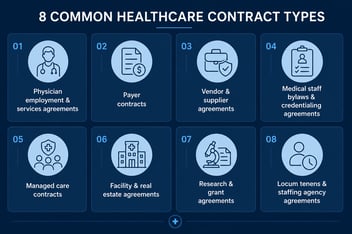
Why generic document search falls short, and what structured contract data does differently.
Artificial intelligence is transforming healthcare contract lifecycle management.
From AI-powered contract search to automated clause extraction and advanced healthcare contract analytics, organizations are exploring how AI can improve visibility, reduce manual review and strengthen compliance oversight.
But not all contract AI is built the same.
If your AI solution relies on unstructured contract data, you may be putting trust in something that does not truly understand your agreements. That is because many AI systems today operate on what is commonly called blob data.
And in healthcare, blob data introduces real risk.

What blob data really means in contract lifecycle management.
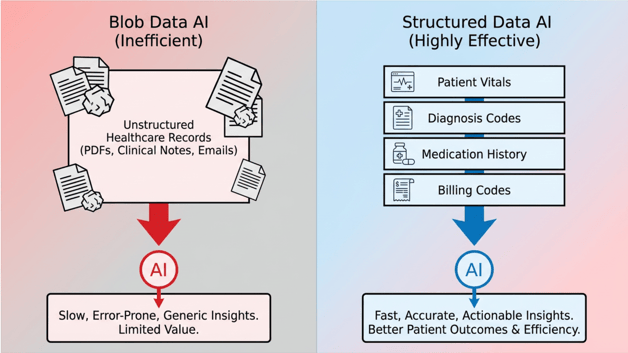
Blob data refers to unstructured contract text that is stored and processed as one large block of content.
In this model, reimbursement terms, regulatory obligations, renewal dates and performance metrics remain embedded in narrative language. The AI can identify phrases, but it does not isolate and classify those clauses into validated, reportable data elements.
Structured contract data does the opposite. It separates and categorizes key contract components, including payment terms, termination rights, quality incentives and compliance requirements. Each data point is intentionally labeled, mapped and validated so healthcare contract analytics and AI-powered contract search operate on defined, reliable inputs rather than raw text.
For simple agreements, blob-style processing may be sufficient.
Healthcare contracts are not simple.
They include complex reimbursement methodologies, value-based care provisions, carve-outs, amendments and regulatory requirements that must be interpreted precisely. If AI cannot distinguish between a reimbursement rate and a quality incentive, the resulting insights may look polished but lack structural integrity.
The problem with unstructured contract text in healthcare.
When AI operates on unstructured contract data, risk multiplies quickly.
Because the model relies on surface-level keyword matching rather than validated clause classification, critical financial and compliance terms can be misinterpreted or overlooked.
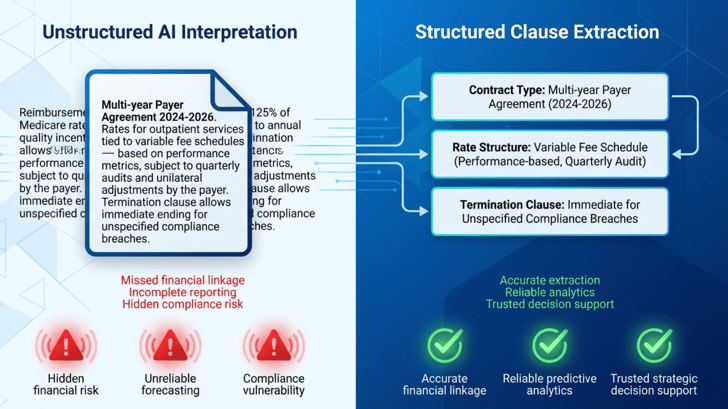
For example, an unstructured AI model may flag a termination clause based on keyword frequency while overlooking the reimbursement rate or quality incentive adjustment embedded in the same paragraph. Without structured clause extraction, essential reimbursement data, performance terms and regulatory obligations remain buried in narrative language instead of being captured as reportable fields.
The result is inconsistent contract reporting and unreliable healthcare contract analytics. Financial terms are not standardized. Compliance obligations are not mapped to governance frameworks. Audit readiness becomes dependent on manual interpretation rather than structured data.
Enterprise AI research consistently shows that unstructured data increases error rates when context is complex. Healthcare contract language is highly contextual, and even a small misclassification can materially affect revenue cycle performance, compliance posture or payer analysis.
In healthcare contract lifecycle management, close enough is not good enough.
What healthcare contract AI really needs.
Healthcare organizations do not need generic document search layered onto contract storage.
They need structured contract data designed specifically for healthcare.
Structured contract data means key terms are intentionally identified, categorized and validated against a defined healthcare taxonomy. Reimbursement clauses are extracted as reimbursement clauses. Renewal dates are captured in standardized date fields. Compliance obligations are mapped to reporting frameworks.
Instead of one large block of searchable text, the contract becomes a system of organized, reportable data elements.
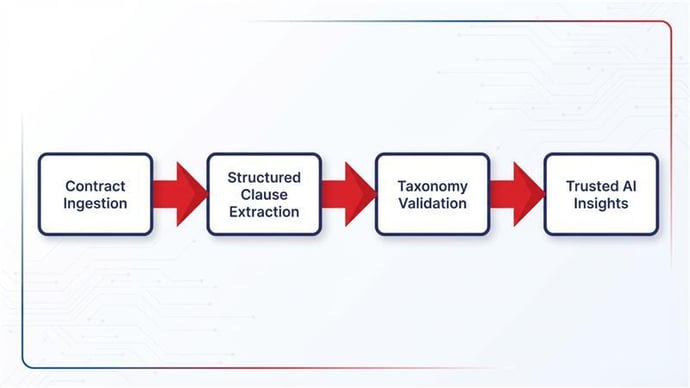
When AI runs on structured contract data:
-
Contract search becomes field-level and precise.
-
Clause extraction aligns with healthcare-specific classifications.
-
Contract analytics reflect verified financial and compliance terms.
-
Reporting becomes defensible across legal, finance and compliance teams.
AI stops guessing. It starts operating on validated intelligence.
How structured data improves clause extraction and contract analytics.
Clause extraction in healthcare is not just about pulling sentences from a document. It’s about understanding what those clauses represent in operational and financial terms.
With structured data:
-
Reimbursement rates can be analyzed across payer agreements.
-
Quality incentive provisions can be compared consistently.
-
Termination rights can be monitored proactively.
-
Compliance obligations can be audited systematically.
This is where true healthcare contract analytics becomes possible.
Without structured data, dashboards may look sophisticated, but the underlying fields may not reflect accurate clause classification. Structured data transforms AI from a document reader into a reliable decision-support engine.
When generic AI introduces risk in healthcare compliance.
Healthcare operates under intense regulatory scrutiny. Contracts directly affect reimbursement accuracy, audit readiness and patient access.
Generic AI solutions built for broad document types do not account for the complexity of healthcare reimbursement models or regulatory language. When those solutions rely on blob data, they introduce subtle but meaningful risk.
Missed clauses can affect revenue forecasting. Misinterpreted obligations can impact compliance reporting. Incomplete metadata can weaken executive decision-making.
The risk is not always visible at first glance.
Dashboards may look clean. Search may feel fast.
But if the underlying contract data is unstructured, trust erodes over time.
Why clean, structured contract data is the foundation of trusted AI.
The future of AI in healthcare contract lifecycle management isn’t about flashier demos or faster keyword search.
It’s about confidence.
AI should increase trust in reporting, not create uncertainty. It should strengthen compliance oversight, not introduce ambiguity. It should support healthcare leaders with reliable, structured insight into the agreements that shape revenue and operations.
That level of trust starts long before the AI model runs.
It starts with how the contract data is built.
If you begin with structured, validated contract data designed for healthcare complexity, AI becomes a force multiplier for visibility and performance.
If you begin with blob data, you are simply layering artificial intelligence on top of unstructured text.
In healthcare, context is everything.
And context requires structure.