Contract lifecycle management plays a critical role in how healthcare organizations manage risk, compliance and financial performance. Yet it is often misunderstood as a purely administrative or legal function.
In reality, contracts shape how healthcare organizations work with vendors, payers, providers and partners across the entire enterprise. They define reimbursement structures, regulatory responsibilities, service expectations and accountability. As healthcare systems grow more complex and regulatory oversight increases, managing contracts effectively has become a strategic imperative.
This guide explains contract lifecycle management through a healthcare lens. It outlines what it is, why it matters, how it works and how healthcare organizations can approach it with greater rigor and clarity.
What is contract lifecycle management?
Contract lifecycle management is the structured, end-to-end process of managing contracts from initial request through execution, performance oversight and eventual renewal or termination. It brings consistency, governance and visibility to agreements that would otherwise be managed in fragmented, manual or reactive ways.
At its core, contract lifecycle management connects people, processes and data across the full life of an agreement. It ensures that contracts are not only executed efficiently but also actively managed over time. When done well, contract lifecycle management transforms contracts from static documents into living sources of operational, financial and compliance insight.
Why is contract lifecycle management important?
Contracts define financial terms, operational expectations and risk exposure across nearly every part of an organization. When contracts are poorly managed, organizations experience delayed execution, missed obligations, unmanaged renewals and increased compliance risk.
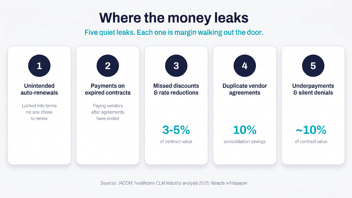
Independent industry research consistently shows that ineffective contract management contributes to revenue leakage, higher administrative costs and reduced visibility into organizational risk. In regulated industries like healthcare, these challenges are magnified due to payer requirements, vendor oversight responsibilities and audit exposure.
Effective contract lifecycle management improves transparency and accountability by ensuring that contract terms are standardized, accessible and actively monitored. This enables organizations to reduce risk, improve efficiency and make informed decisions grounded in contract performance rather than assumptions.
What are the key steps in the contract lifecycle?
While terminology may vary by organization, effective contract lifecycle management follows a consistent sequence of steps that guide an agreement from initial request through long-term oversight and decision-making.
Step 1. Contract request and intake.
The lifecycle begins when a business need for an agreement is identified. During intake, key details such as contract type, parties involved, scope and risk considerations are documented to ensure the request is complete and aligned with organizational policy.
Step 2. Drafting and authoring.
Contracts are drafted using standardized templates and pre-approved language. This step helps reduce inconsistency, minimize legal and regulatory risk and accelerate turnaround times while ensuring alignment with organizational and compliance requirements.
Step 3. Review and negotiation.
Stakeholders review contract terms to assess risk, clarify obligations and negotiate conditions as needed. Legal, compliance, finance and operational teams often collaborate during this step to ensure the agreement supports both business objectives and governance standards.
Step 4. Approval and execution.
Once finalized, the contract moves through formal approval workflows. After required sign-offs are obtained, the agreement is executed and becomes legally binding.
Step 5. Ongoing management and performance oversight.
After execution, the contract enters an active management phase. Key terms, obligations, service levels and compliance requirements are monitored to ensure both parties meet their commitments throughout the contract term.
Step 6. Renewal, amendment or termination.
As contracts approach key milestones, organizations evaluate performance, compliance and risk to determine whether to renew, amend or terminate the agreement. Decisions are informed by historical data, contractual outcomes and evolving organizational needs.
Managing these steps within a unified framework ensures continuity, accountability and institutional knowledge across the full lifecycle of every contract.
What challenges do organizations face without structured contract lifecycle management?
Without a structured approach, contracts are often stored across shared drives, inboxes or department-specific systems. This fragmentation makes it difficult to locate agreements, track obligations or understand overall risk exposure.
Manual processes increase cycle times and introduce errors, particularly during review, approval and renewal stages. Inconsistent templates and terms complicate compliance and enforcement, while cross-functional misalignment slows collaboration and decision-making.
Over time, these challenges contribute to operational inefficiencies, missed renewal opportunities and heightened compliance risk.
How does contract lifecycle management support compliance and risk management?
Contracts often include regulatory requirements, service level commitments and audit provisions that must be actively monitored. Contract lifecycle management supports compliance by centralizing contract data and making critical terms visible, searchable and reportable.
Standardized templates help reduce the risk of non-compliant language, while ongoing oversight ensures obligations are addressed proactively rather than discovered during audits or disputes.
In healthcare, where regulatory requirements continue to evolve, proactive contract oversight helps organizations identify and mitigate risk before it escalates into financial or operational disruption.
How do healthcare regulations shape contract lifecycle management?
Healthcare contracts operate within a complex regulatory environment that includes federal, state and payer-specific requirements. Agreements may need to account for fraud and abuse laws, data privacy standards, reimbursement rules and quality reporting obligations.
Contract lifecycle management helps organizations operationalize these requirements by ensuring regulatory language is applied consistently and monitored throughout the life of the agreement. Rather than treating compliance as a one-time review, organizations use ongoing oversight to align contracts with regulatory expectations.
What role does contract lifecycle management play in vendor and third-party oversight?
Healthcare organizations rely on a wide network of vendors and third parties to support clinical, operational and administrative functions. These relationships often involve access to protected health information or delivery of services that directly impact patient care.
Contract lifecycle management enables organizations to maintain visibility into vendor responsibilities, service levels and compliance requirements. By tracking obligations over time, healthcare teams can demonstrate appropriate oversight and accountability rather than relying on periodic or ad hoc reviews.
How does contract lifecycle management support payer and reimbursement integrity?
Payer agreements define reimbursement methodologies, performance requirements and dispute resolution processes. Without centralized visibility into these terms, organizations may struggle to validate payments, manage denials or enforce contractual rights.
Contract lifecycle management provides structured access to payer contract data, enabling finance and revenue cycle teams to align reimbursement performance with contract terms. This visibility supports more accurate forecasting and helps reduce revenue leakage caused by misaligned or misunderstood agreements.
How does contract lifecycle management support audits and investigations?
Audits and investigations often require rapid access to executed agreements, amendments and supporting documentation. When contracts are dispersed across systems, responding to these requests becomes time-consuming and disruptive.
Centralized contract lifecycle management allows organizations to retrieve contracts, approvals and historical changes efficiently. This documentation trail supports defensibility and reduces operational strain during audits or regulatory inquiries.
How does contract lifecycle management impact mergers, acquisitions and growth?
During mergers, acquisitions or organizational expansion, contracts play a critical role in understanding financial commitments, risk exposure and integration requirements. Incomplete or inaccurate contract data can delay transactions or introduce post-close surprises.
Contract lifecycle management provides a consolidated view of active agreements, renewal obligations and termination rights. This clarity supports due diligence efforts and smoother operational integration as organizations grow.
How is technology changing contract lifecycle management?
Advances in automation, analytics and artificial intelligence have reshaped how organizations manage contracts. These capabilities reduce manual effort by streamlining intake, approvals and execution, while surfacing insights across large contract portfolios.
Analytics allow organizations to identify performance trends, assess risk at scale and address issues proactively. As a result, contract lifecycle management increasingly supports strategic planning and governance rather than serving solely as an administrative function.
How can healthcare organizations measure the success of their contract lifecycle management efforts?
Measuring success requires more than tracking contract volume or execution speed. Healthcare organizations often evaluate metrics such as cycle time reduction, renewal timeliness, compliance adherence and obligation fulfillment.
More mature programs also assess how contract insights support financial performance, risk mitigation and operational alignment. These measures help leadership understand how contract governance contributes to broader organizational goals.
In healthcare, contracts influence far more than legal outcomes. They shape financial performance, regulatory compliance, vendor accountability and operational stability. As organizations navigate increasing complexity and oversight, contract lifecycle management has become a foundational discipline rather than a supporting function.
By taking a structured, end-to-end approach to managing contracts, healthcare organizations gain the visibility and control needed to reduce risk, improve efficiency and make informed decisions. Treating contracts as strategic assets enables stronger governance today and greater resilience in the future.