Artificial intelligence is reshaping how healthcare organizations approach documentation, including policy development. The ability to generate drafts in seconds can feel transformative for teams navigating complex regulations, limited resources and constant change.
AI can absolutely be helpful.
But policies that guide clinical practice require more than efficiency. They must function in real care environments, for real nurses and real patients. That is where RN-informed policy makes the difference.
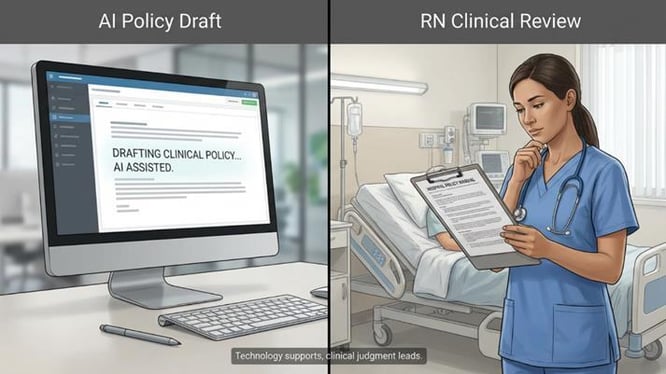
Technology drafts. Clinicians validate.
What AI can and cannot do in clinical policy writing.
AI has earned a seat at the table. When used responsibly, it can support policy teams by:
-
Creating initial drafts and structured outlines
-
Summarizing regulatory requirements and standards
-
Standardizing formatting and organization
-
Reducing blank page delays
-
Accelerating early-stage development
For organizations facing mounting compliance demands, this type of speed matters. In many cases, it’s necessary.
But speed alone does not create safe, defensible policy.
Why clinical judgment matters in healthcare policy.
Healthcare policy is not generic documentation. It’s clinical guidance that shapes care delivery, informs high-risk decision-making and protects both patients and organizations.
AI lacks what healthcare policy depends on most: clinical judgment.
AI cannot:
-
Draw from lived nursing experience
-
Anticipate how policies function during short staffing or high acuity shifts
-
Recognize workflow breakdowns or common workarounds
-
Interpret regulatory intent in context
-
Apply nuance to complex patient scenarios
An AI-generated policy may appear polished. Without clinical insight, however, it can become impractical, disconnected from frontline reality or difficult to defend under scrutiny.
In healthcare, those gaps carry real consequences.
What RN-informed policy means for patient safety and compliance.
RN-informed policy is not a final review or a signature of approval. It means policies are written, shaped and validated by nurses who understand patient care firsthand.
RN-informed policies:
-
Reflect actual clinical workflows
-
Balance compliance with patient safety
-
Identify potential failure points before implementation
-
Use language clinicians can confidently apply
-
Withstand audits, investigations and adverse events
Nurses understand not only what a policy says, but why it exists. That perspective is essential when policies guide decisions at the bedside.
Balancing AI efficiency with nursing expertise.
The future of healthcare policy is not about choosing AI or nurses. It’s about defining the right role for each.
From draft to defensible policy, clinical leadership remains central.
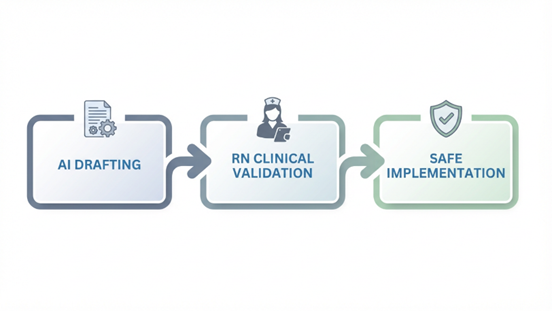
AI can:
-
Accelerate drafting
-
Improve structural consistency
-
Support organization
RNs:
-
Apply clinical judgment
-
Validate real-world applicability
-
Safeguard patient safety
-
Ensure credibility and defensibility
The strongest policies combine intelligent technology with irreplaceable human expertise. Clinical leadership must remain at the center.
Defensible healthcare policies in a high-scrutiny environment.
Healthcare organizations face increasing pressure to do more with fewer resources, tighter timelines and heightened scrutiny.
In that environment, automation can feel like the answer.
But policies are not theoretical documents. They are instructions for care. When events are reviewed, leaders do not ask how quickly a policy was written. They ask whether it was practical, clear and safe in application.
RN-informed policy is not optional. It’s a safeguard for patients, clinicians and organizations.
The future of healthcare policy is clinically led.
At Ntracts, we recognize the power of innovation. We also recognize that technology does not replace clinical expertise.
Built on the legacy of MCN Solutions, our policy content is developed with RN expertise at its core. That means guidance grounded in how care is actually delivered, not simply how it’s documented.
AI may help initiate a draft. Nurses ensure it protects patients and stands up to scrutiny.
Technology will continue to evolve. Regulations will continue to shift. The need for clinical judgment in healthcare policy will remain constant.
AI can draft policies.
RNs make them work.